Bluey is a smash-hit show for young families known for its tender, accessible, and realistic handling of the emotions that come with growing up. In an Australia full of dog people, Bluey and her little sister Bingo use their big imaginations to make sense of the world around them. Meanwhile, parents Bandit and Chili do their own growing, as they learn to balance indulging in make-believe and their own adult responsibilities. The duality has launched Bluey out of its target demographic and into a more general audience. If only that crossover appeal had been applied to Bluey’s Quest for the Gold Pen.
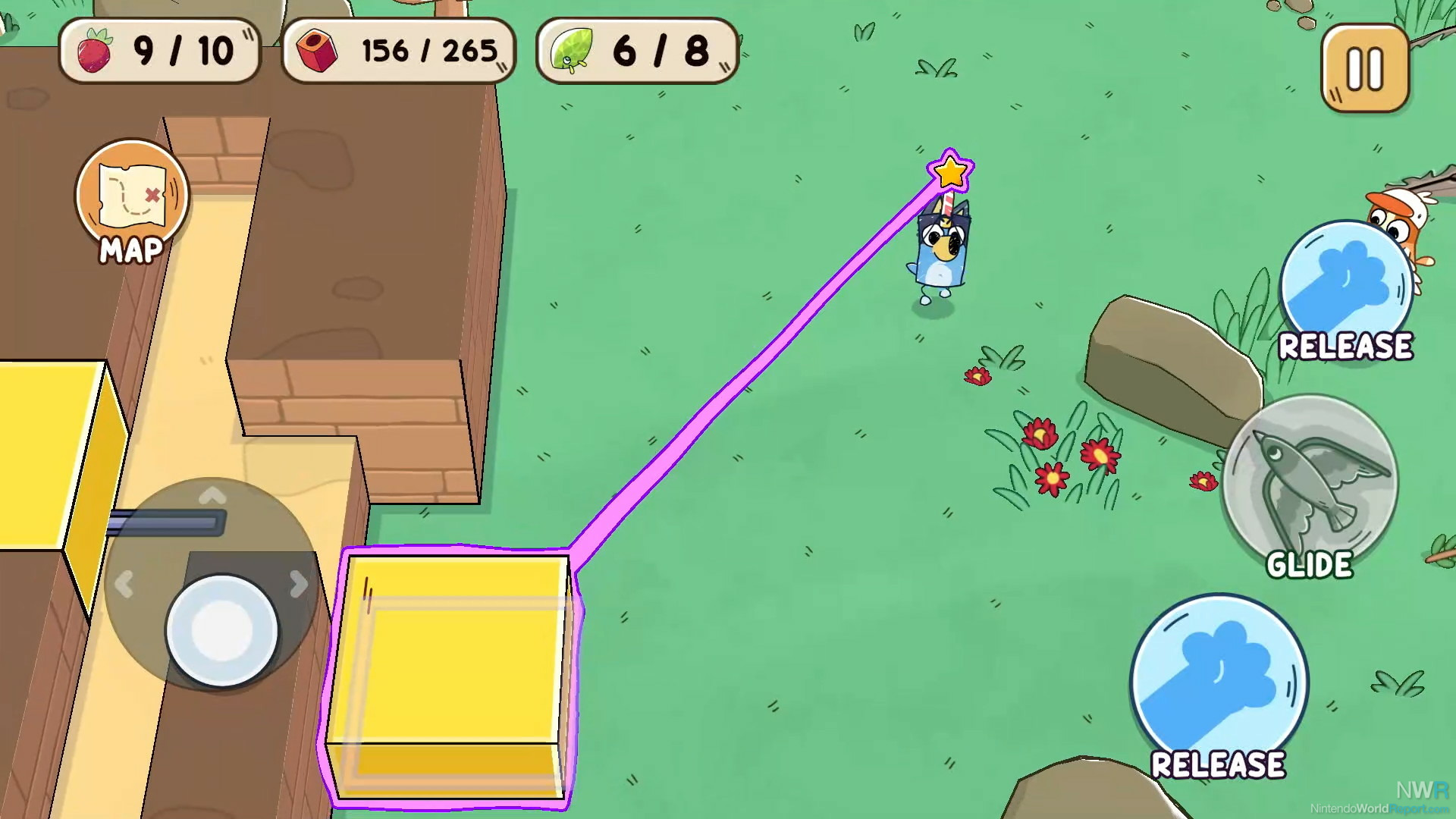
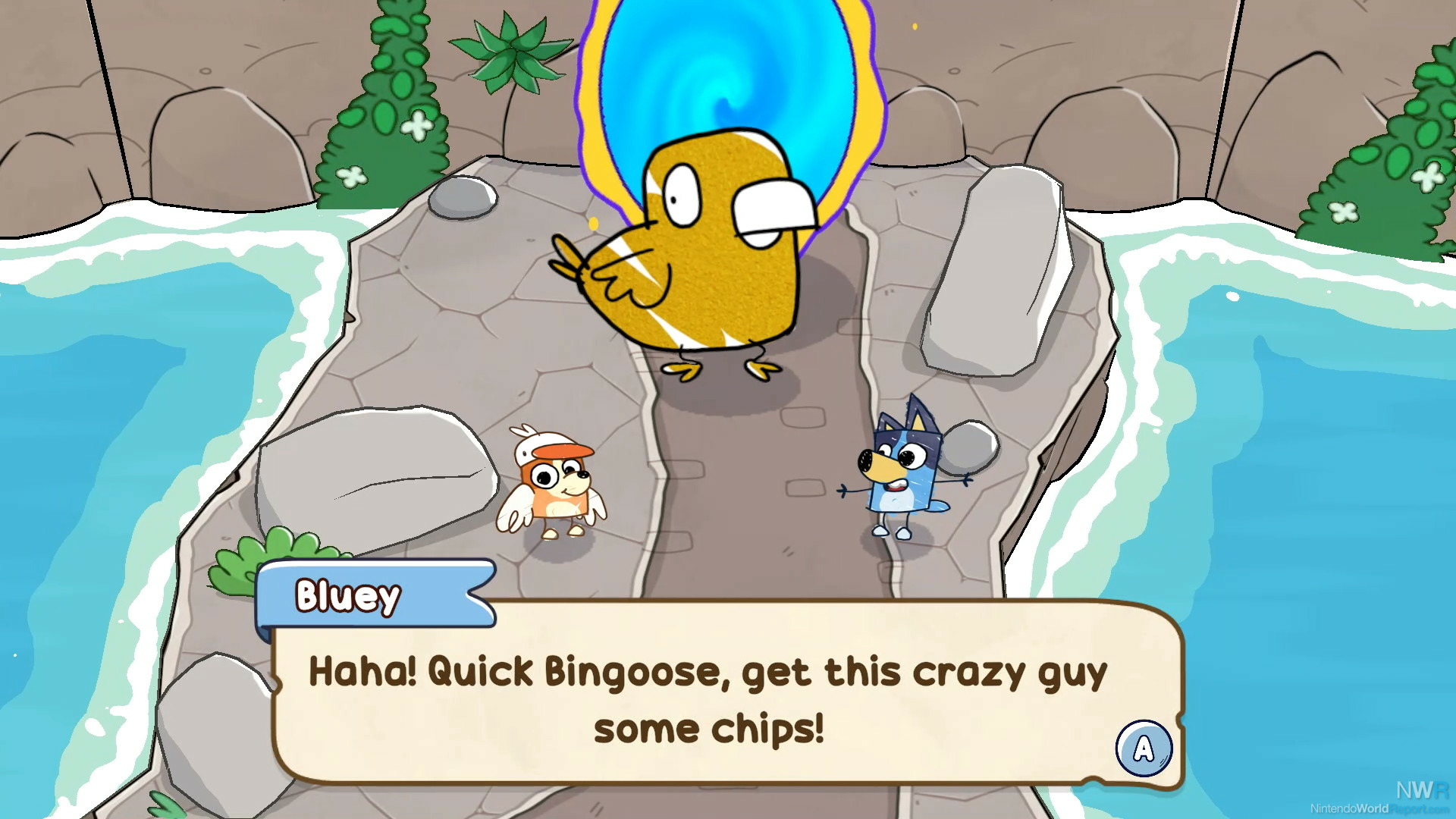
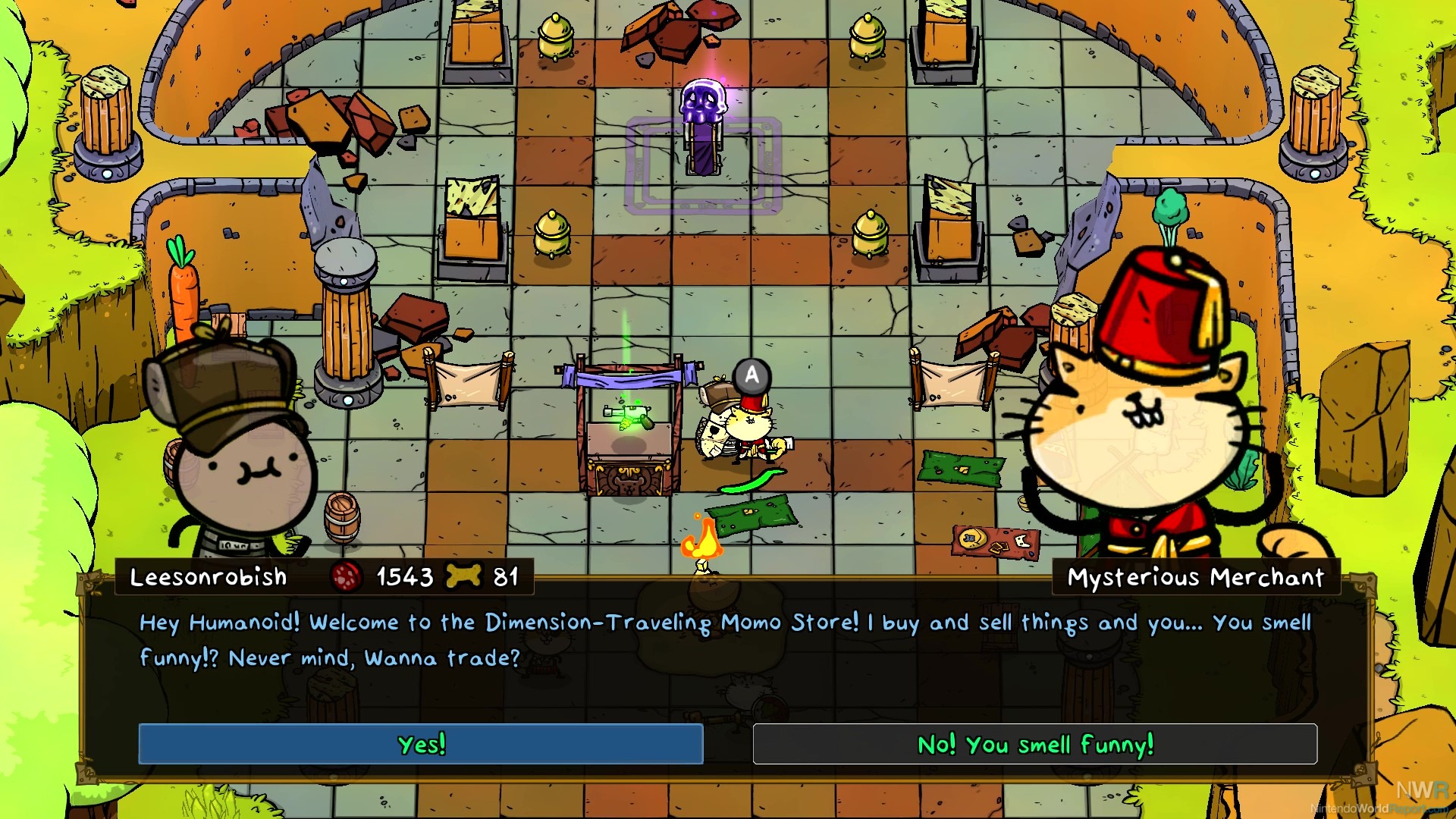
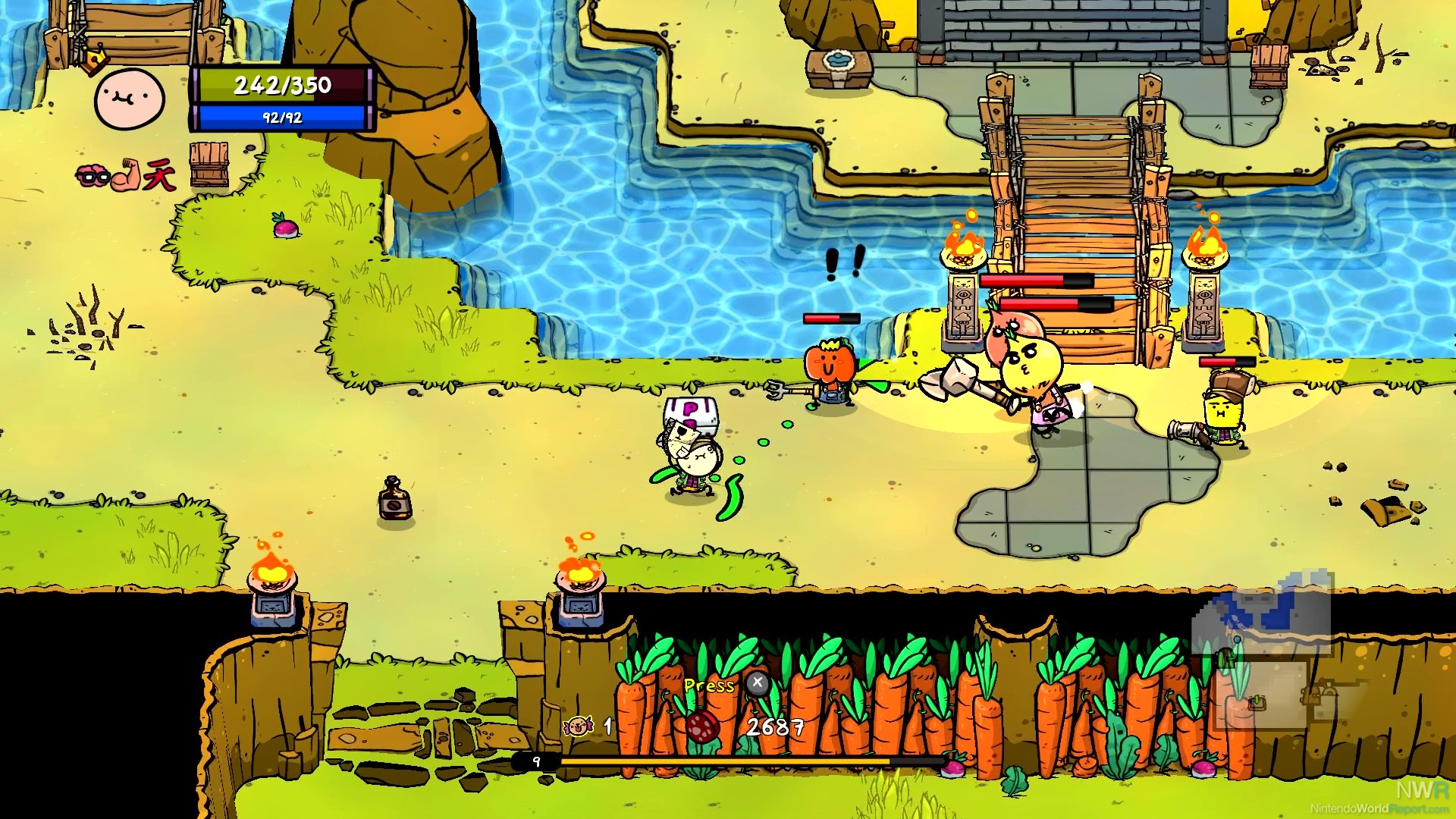
Bluey’s latest adventure is a top-down collect-a-thon set across a series of hand-scribbled fantasy lands. Dad fills the villain role, ruling the kingdom with his gold pen, while Mum draws the levels and gives quests. “Bingoose” (half Bingo, half goose) floats close by, honking at map markers. Bluey starts with a wand that can move blocks and press switches but has different moves for each level, like a glide or rocket boost. Puzzles are simple introductions to basic video game concepts, like platforming or mazes, with a gentle difficulty curve and no fail states. Each level has the same four collectibles: beads hidden in flowers, tiny creatures, kids playing hide-and-seek, and goose food. The first three collectibles award more goose food, and enough goose food lets Bingoose lay a magic egg that hatches into whatever MacGuffin placates the villain blocking the path to the next level.
Each level has a different theme but carries the core collectibles and gameplay loop throughout. Bluey needs just a fraction of a level’s goose food to proceed to the next, so more difficult collectibles can be left for later. The themes are generally recolors of the same backgrounds and don’t offer memorable landmarks. Every NPC is a variation of the same gnome, and while they have cute dialogue, the wordplay and grammar puns ask for the reading ability of someone old enough to play games with more depth.
Cutscenes between levels look and sound like clips from the show as the family teases and taunts each other about the next part of the adventure, but this is not some lost episode. Bandit’s constant one-upsmanship, while a convenient excuse to add yet another level, has him come off as much more of a bully than in a traditional Bluey story. Every scene takes place at the same table with the same topic of conversation, but the zingers and voice acting do nail the feel.
Bluey’s Quest for the Gold Pen is an unremarkable, mindless, repetitive bore only notable for its Bluey branding. The plot, a new story by the show’s creator, is barely a premise as the characters show no growth narratively or mechanically. Very young players might be entertained but will need a parent or older sibling to read the dialogue in this entirely single-player adventure. The touch controls from the original mobile release are here and work fine, though.
To consider the Mega Man Star Force series without comparing it to the Mega Man Battle Network series is impossible for anyone familiar with both. It seems to have been just as difficult a distinction to make for the developers. Star Force is at once a sequel, a reboot, and oblivious to what came before.
For context, Battle Network imagined a world where everyone was addicted to their phones that hooked into every appliance. Users could control an AI buddy to run around the internet and battle viruses. The main character’s AI buddy, Mega Man, was very special for extremely anime plot reasons. Battle Network could be considered a minor phenomenon with annual GBA releases, tons of toys, and a localized anime series.
Instead of continuing Battle Network on DS, Capcom released Mega Man Star Force in three flavors: Leo, Pegasus, and Dragon. The biggest difference seems to be which sky NPC grants you a special battle ability, but all share the same story. Geo Stelar, a sad boy, partners with Omega-Xis, a gruff alien warrior no one else can see, to fight wi-fi aliens bent on destroying Earth. When merged, they become Mega Man, the only human capable of traversing the wave world.
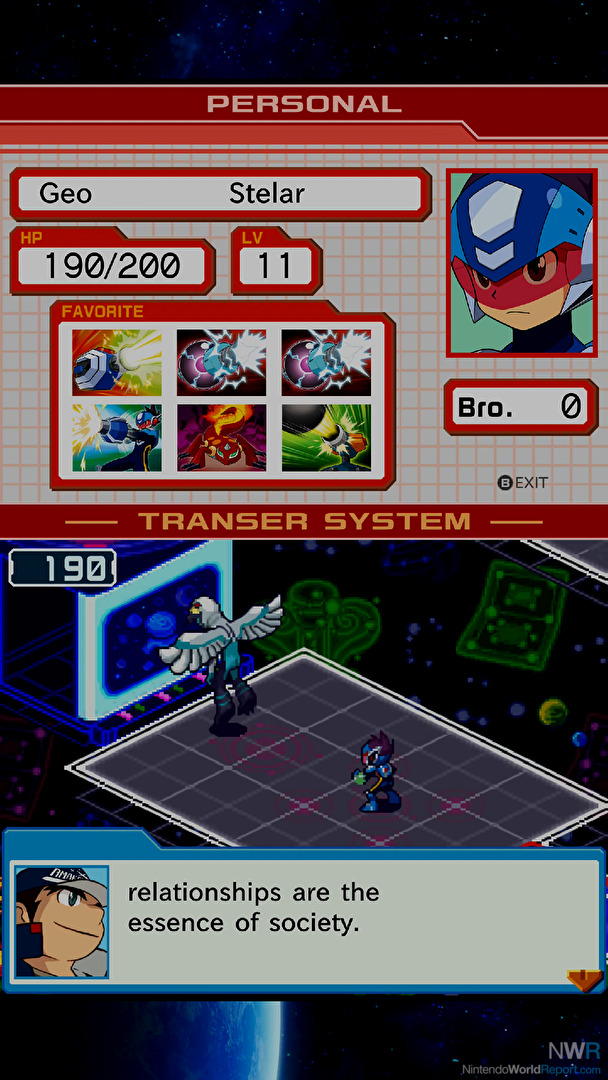
Geo and Mega both struggle to open up, Geo stunted by the loss of his astronaut father and Mega obsessed with revenge against the aliens pursuing him. They slowly learn to trust each other – and others – as each scenario unfolds. Instead of making friends, people in the Star Force universe make Brother Bands, something between a platonic marriage and a phone contact. Brothers give Mega Man passive abilities in battle and occasionally trigger special attacks. Although Brother Bands are a driving force in the story, including being the life’s work that got Geo’s dad killed in space, Geo only becomes Brothers with two girls and no boys until the very end of the first game.
Battle Network’s leads seem to make friends effortlessly and are closer than brothers. The internet they explore is full of people, but Star Force’s wave world is a disconnected, empty loneliness. The wave world is overlayed on the physical world, removing the abstraction of Battle Network’s web and mirroring the emotional barrier between Geo and the world. He can’t start a conversation without first looking through a person’s phone to learn about them. Mega Man as a secret alter ego becomes the mask for his depression and the conduit for his rehabilitation. Geo is the one sad about his dad. Mega Man is here to help. By the start of Star Force 3, everyone can see the wave world, and everyone has a little AI buddy on their phone.
To imply the story has much depth would be misleading, but it does offer a comforting cadence to those of the era and an episodic narrative alternative to modern ongoing service games. Story arcs play out like a Saturday morning cartoon, and you can guess who the next boss will be as soon as they appear onscreen. Geo probably befriends them. Nearly every object in the world has a description, and game mechanics fit the internal world logic no matter how contrived. Here is a fully realized world you can stop in to stay a while, if you’d like. As long as you can withstand the camp.
However, Star Force’s battle system is probably a much bigger factor in whether you’d like to stay. Mega Man dazzles in a new behind-the-back perspective, thanks to the increased power of the Nintendo DS, as he dodges left and right for the opportunity to strike. Every few seconds, the player can choose moves from a hand of six cards, then time their use with the A button. B fires off a little blaster, Down jumps you forward to an enemy, and Y puts up a simple shield. Countering an enemy just as it attacks stuns that enemy and gives Mega Man a bonus attack.
Geo has hundreds of cards to collect in each game, and the Legacy Collection adds long-lost cards from Japanese toys and events. The huge variety of attacks and different form changes in each entry keep battles from getting stale, especially as enemy attacks get harder to dodge. The chip-code system and secret combos from Battle Network are gone, so cards work in any combinations, simplifying deck-building. Battle cards, health power-ups, and weapons litter the wave world’s mazes and dungeons, and nearly every NPC gets a sidequest.
The series looks nice on Switch with multiple viewing options to juggle the DS’s screens and toggleable high-res options. Paired with the optional new music, Star Force could pass for a modern indie, although the pixel smoothing looks a bit smeary. Unfortunately, the text and a few other UI elements are trapped in ultra-smooth HD, so the perfect retro look is out of reach. A built-in cheat menu can unstick some stubbornness, like turning down encounters when a puzzle asks you to memorize a combination from the other side of the map.
Other bonus stuff includes a gallery, a jukebox where you can replace the battle music with other tracks (but not the omnipresent crisis music), and an achievement menu. Achievements were mostly things like “beat the game” or “collect every card” and didn’t seem to unlock anything. There’s also a robust menu for online multiplayer, but no one seemed to be online during the review period.
This being a Legacy Collection brings up the question of Star Force’s legacy. While not bad games, the series is more continuation than evolution of the previous series, especially in presentation, story, and age range. Star Force 3 was also the direct predecessor to the somewhat ongoing Mega Man drought. While the perfect cure for a shonen anime friendship speech craving, Mega Man Star Force Legacy Collection feels a bit interchangeable with what came before.
Almost twenty years after the first Mega Man Star Force launched on DS, the trilogy is coming to Switch and other consoles March 27th, 2026. Mega Man Star Force Legacy Collection contains every version of each game, plus bonus features and a gallery to truly immerse yourself in the town of Echo Ridge.
Building on the Mega Man Battle Network series (and a wild departure from Mega Man’s platforming roots), Star Force follows new protagonist Geo Stelar, a depressed pre-teen possessed by Omega-Xis, an invisible alien who may have known Geo’s missing astronaut father. Together, the two become Mega Man, the only person who can protect the planet from computer viruses raining down from space. With the help of his dead dad’s research goggles, Geo can see the Wave World, essentially Wi-Fi pathways overlaying the physical world. Mega Man can traverse these paths to sneak into electronics or even pop out someplace else.
The real-time battles take place on a grid with a behind-the-back camera. Mega Man comes with an upgradable buster, but his real attacks come from Battle Cards. Every few seconds, Mega Man can pull up a menu of six cards to choose from in specific combinations: a column of two, identical matches, or random white wild cards. Time unfreezes, and Mega Man dodges left and right to line up his attacks, ranging from flaming yoyos to area-of-effect bombs. Pressing down lets Mega Man lock onto an enemy and jump forward to attack.
For our preview, we played through the first few story arcs of Star Force: Leo. Scenarios may feel familiar to fans of Battle Network or other grade-school adventure series. Geo, a homeschooled recluse, tries to dodge his would-be classmates and uncover the details of his dad’s final mission when something goes awry. Mega Man sneaks into the labyrinthian dungeon within whatever malfunctioning electronic to solve puzzles before battling the alien that possessed the most recently introduced NPC-with-a-tragic-backstory. While Mega Man may be powerful, the friendship speech in the cutscene after the battle is what really saves the day. Geo learns a bit about friendship, too. The increasingly outrageous situations pair with a perfectly al dente translation to recapture a comforting mid-aughts magic long thought lost.
The trilogy’s new Legacy Collection wrapper greets you with a fully voiced 3D Mega Man, all seven games in the trilogy, a gallery with jukebox, and a deep settings menu. Players can toggle the new art, music, and high-res filter, and choose how the DS’s two screen display on the Switch. I must apologize to our YouTube audience for how much time I spent in vertical mode. Built-in cheats are much more granular than a win button with sliders for the random encounter rate and damage done or taken. My favorite cheats are the increased overworld speed and sprites for the previously invisible secret boss rematches. They also threw in achievements and a list of passwords to unlock rare items.
Star Force is technically the most recent Mega Man series, and aside from Legends, these were the most notable entries missing from modern consoles. Yes, they are important to Mega Man’s legacy, but they also represent a genre that has almost disappeared: handheld RPGs. The episodic story of daily growth, the cards to collect, the secret bosses to uncover. Mega Man RPGs dare to ask to stay in your handheld all summer, and they justify that request with depth.
Lil Gator Game is a Zelda with no combat, puzzles, or dungeons. Instead, the little green Hero goes on an imagined fantasy adventure across the park to unite the kingdom and hopefully distract their older sister from her homework. The gator, equipped with a stick sword, pot-lid shield, and T-shirt paraglider, destroys cardboard monsters placed across the park’s two islands while meeting and befriending other kids at the park. It’s cute, controls great, and is about as short as its lil gator hero.
Its In the Dark DLC sees Darklord, a bratty pig kid, threaten to destroy the cardboard town on the playground just minutes after the original story’s end. The Hero and friends chase Darklord underground to find pretty much the same setup as the original: cardboard monsters to destroy, kids to befriend, and three main quests. While not big or different enough to stand alone as a sequel, In the Dark builds on the original Lil Gator Game in surprising ways that still feel natural.
Gator keeps the costumes from the first story, including the secret reward that grants unlimited climbing stamina. In the Dark answers with a beautiful underground maze full of interwoven paths and verticality that would look strange in the overworld’s playground. Platforming takes much more of a focus here, but not enough to be considered a challenge. The cave is almost too big to get away with not having a map.
A second stamina system, represented by star charms dangling from new weapons, grants the gator awesome new movement abilities. Double jump, hover, and dash make traversal a total speed fest, especially when paired with the base game’s shield surfing. That’s all they can be paired with, though, as those abilities are tied to weapons that can only be equipped one at a time.
As fun as it is to move around, it’s all in service of hunting down new friends. The writing delights in small, interpersonal vignettes that each explore some coming-of-age insecurity through a nonchalant innocence. Very few friends take more than seconds to recruit, most just needing a short chat with the extra friendly Hero. Characters have defined personalities accentuated by unique typing styles for each; the Hero’s rejection of capital letters reflects a youthful indifference to conventions, and Darklord’s random all-cap words feel like a kid throwing a tantrum.
Whether these kids’ mini existential crises are enough to carry the experience depends on the player. While everything is so cute and incredibly well-written, it straddles the line between relatable for children and a saccharine wistfulness for one’s own youth, a story that played out well enough in the base game. In the Dark’s plot is less special but doesn’t feel out of place.
Lil Gator Game: In the Dark is just as cozy as the base game. Zipping around the island looking for cardboard monsters to smash and new friends to make stays wildly relaxing, but the lack of any challenges dampens the sense of accomplishment. The cool new moves don’t have much of a purpose, and the lack of a map can get one lost. Maybe that’s the point, to get lost playing with movement tech while you think your thoughts. If so, they nailed it.
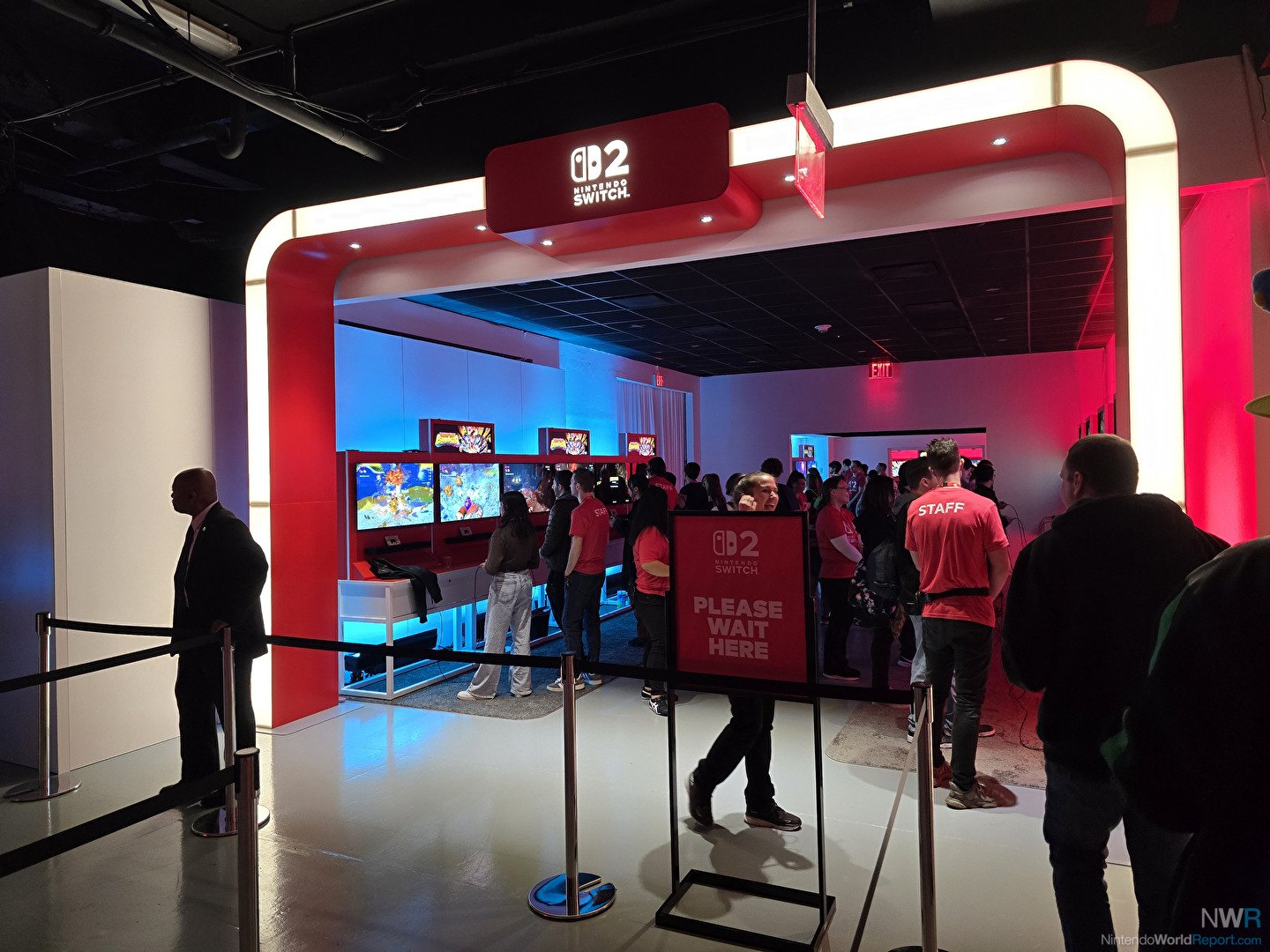
A gloomy day in New York City couldn't dampen my excitement to play the Nintendo Switch 2. Almost 50 players lined up behind me, just enough for two full Mario Kart World lobbies. A security guard eyed me suspiciously and checked my ID (and no one else's) before we were unleashed on the showroom. The massive, two-story event was staffed by more than 150 employees, the biggest show staff Nintendo has ever assembled, they told me.
The Hardware
Glass cases with every Switch 2 set-up and accessory lined one wall, and dummy Switch 2's lined the other. The system itself feels premium with a cool, matte feeling. It's a big upgrade from the plastic-y Fisher-Price feel of the launch Switch but a natural step from the Switch OLED's. The only real complaint one could make is how familiar it is, a literal Switch 2.
The Joy-Con 2 release button is aggressively satisfying. Strong magnets hold them firmly in place with no wiggle, but the release shoots them out almost as if the magnets' polarity reversed. They connect and disconnect like well-oiled pistons, no awkward positioning like the original Joy-Con. As a fidget toy alone, Switch 2 justifies its price.
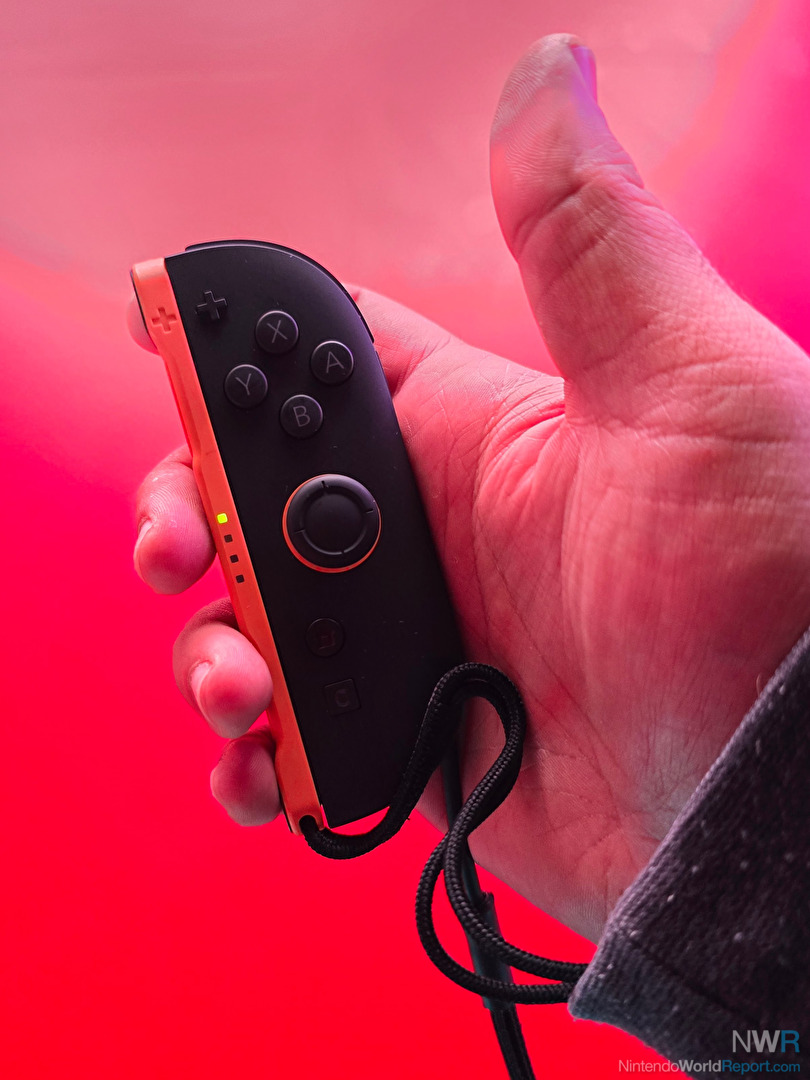
However, the controllers themselves highlight the inherent flaw of the originals. Even with a larger size, the Joy-Con 2 are not hand shaped and still feel tiny in my large man hands. The new controllers might be big enough to accommodate more people, but I've been spoiled by giant third-party alternatives and will most likely stick with those.
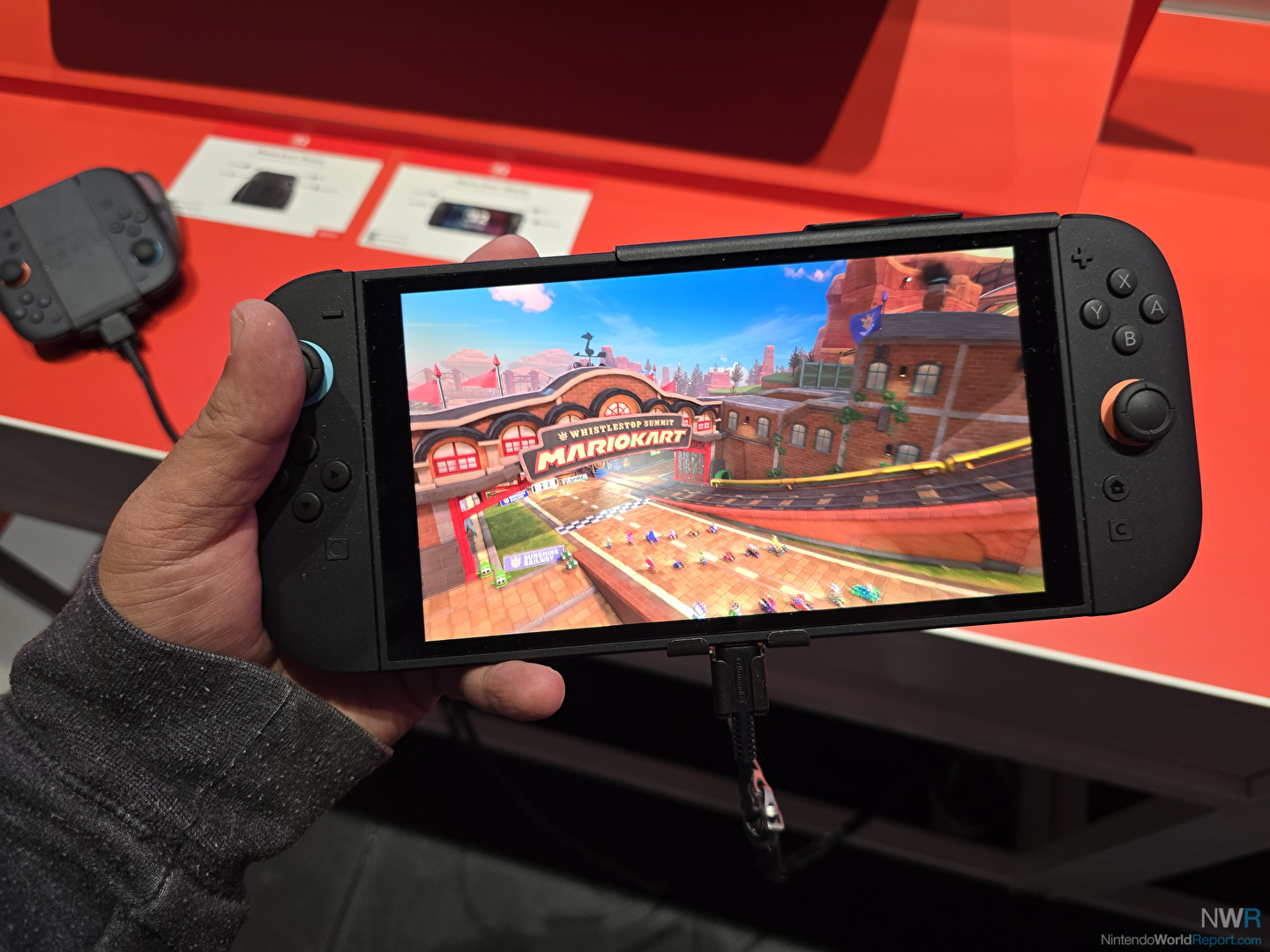
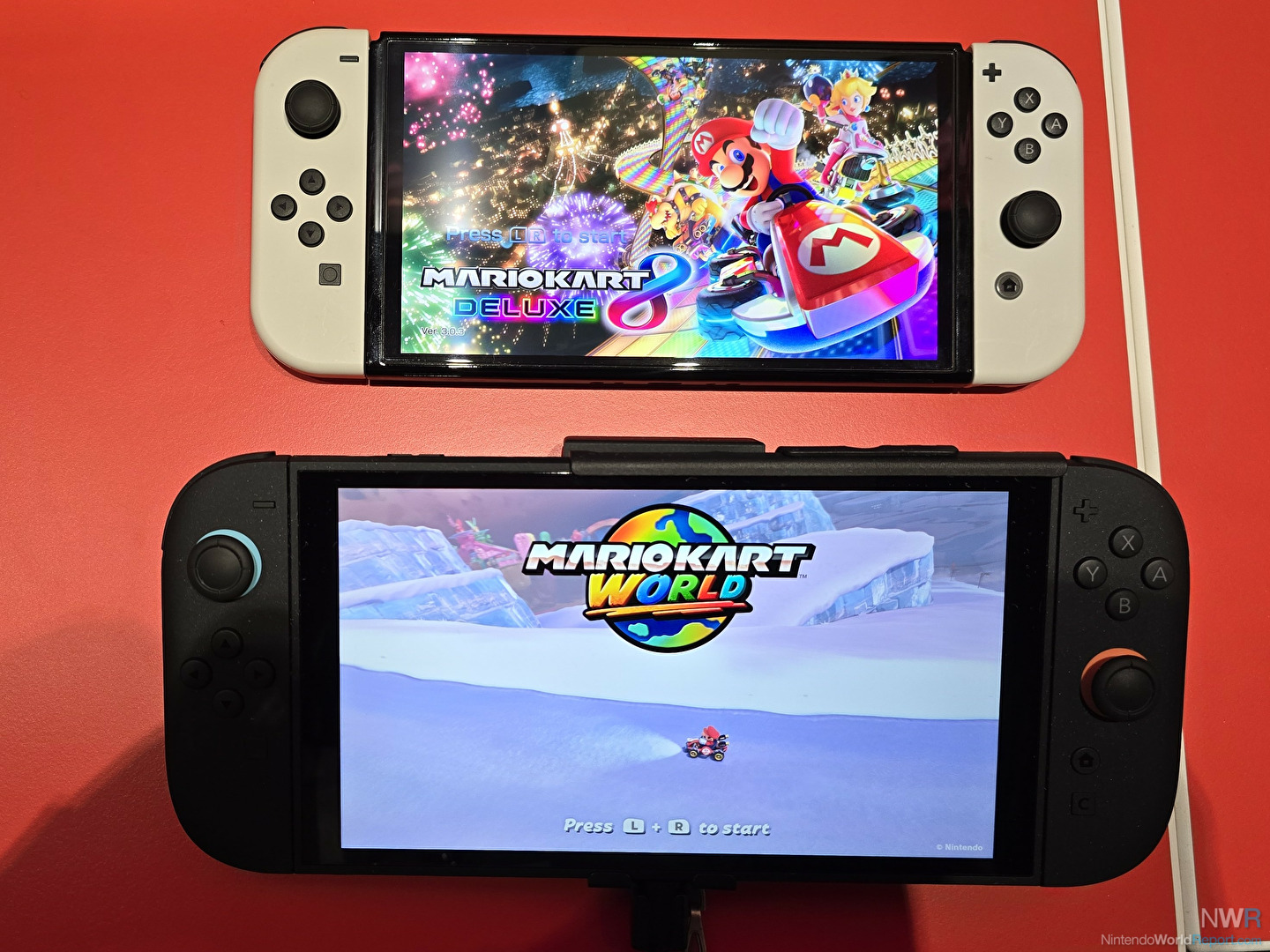
My time with the Switch 2's screen was limited to a couple Mario Kart World races. I was not blown away by the screen like the first time I saw the OLED, but it was plenty bright and colorful. Even next to my OLED Switch, the only difference I noticed was the Switch 2's massive size. This LCD is not a downgrade.
The Switch 2 Pro Controller has wider, flatter buttons and a bigger D-pad. The grips feel somewhat more angled inward and have new GL and GR buttons flush with the back of the grips. The reps wouldn't tell me what the grip buttons did, but Nintendo's website says they can be custom mapped to copy another button. It adds a headphone jack and C-button to launch GameChat but isn't a necessary upgrade to the old Pro Controller, which still works with the Switch 2. It's fine.
The Games
Mario Kart World
We were paired up to play Mario Kart World on 100cc against 22 CPUs. The demo had 60 characters to choose from, a good mix of zany deep cuts and costumed fan favorites. I chose the new Biker Bowser and put him on a Standard Bike. Kart customization is gone, but players can still open the detail menu to compare kart stats, like Speed and Handling.
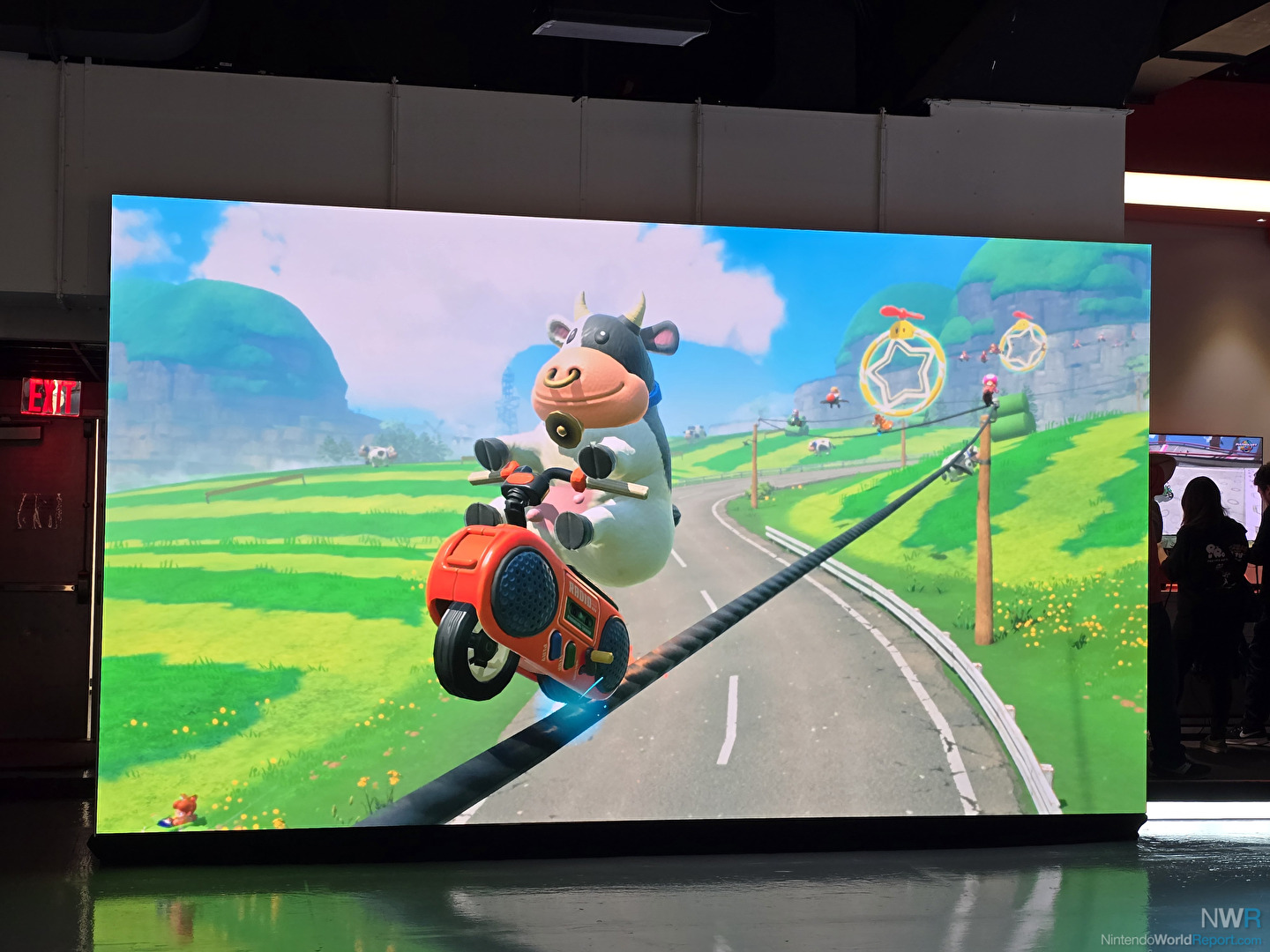
Embarrassingly, I can't remember what course we played first. I can't remember any of the courses I played. The majority of World's courses are segmented instead of lapped, so it's hard as a newcomer to get the lay of the land. Everything is much wider to accommodate 24 racers, up from 12 in Mario Kart 8 Deluxe, so courses felt less guided – and less tight. I felt a little sluggish, too. In previous entries, I'm usually way ahead of the CPUs, drifting and boosting through curves, but here I found myself in the middle of the pack for most of the race with other racers pulling ahead. Boosts from drifts and tricks seemed to have less of an oomph, and multiple midair tricks didn't seem to stack. But in traditional Mario Kart fashion, players in a lower place get better items, and some well-timed mushrooms and shells brought me up to second place. I was surprised by how quickly (and often) we all traded positions. The CPU racers actually hold their own this time.
Next, we moved into a Knockout Tour. 24 players race through multiple courses, but those lagging behind get cut at checkpoints. The lobby for multiplayer drops you into Free Roam mode, allowing us to explore the interconnected world as everyone got set up. I practiced my rail grinding, a new mechanic in Mario Kart World, and hunted down another player for shell target practice. I then stumbled upon an eerie forest with a flock of wild Super Stars leaping through a clearing. Neat.
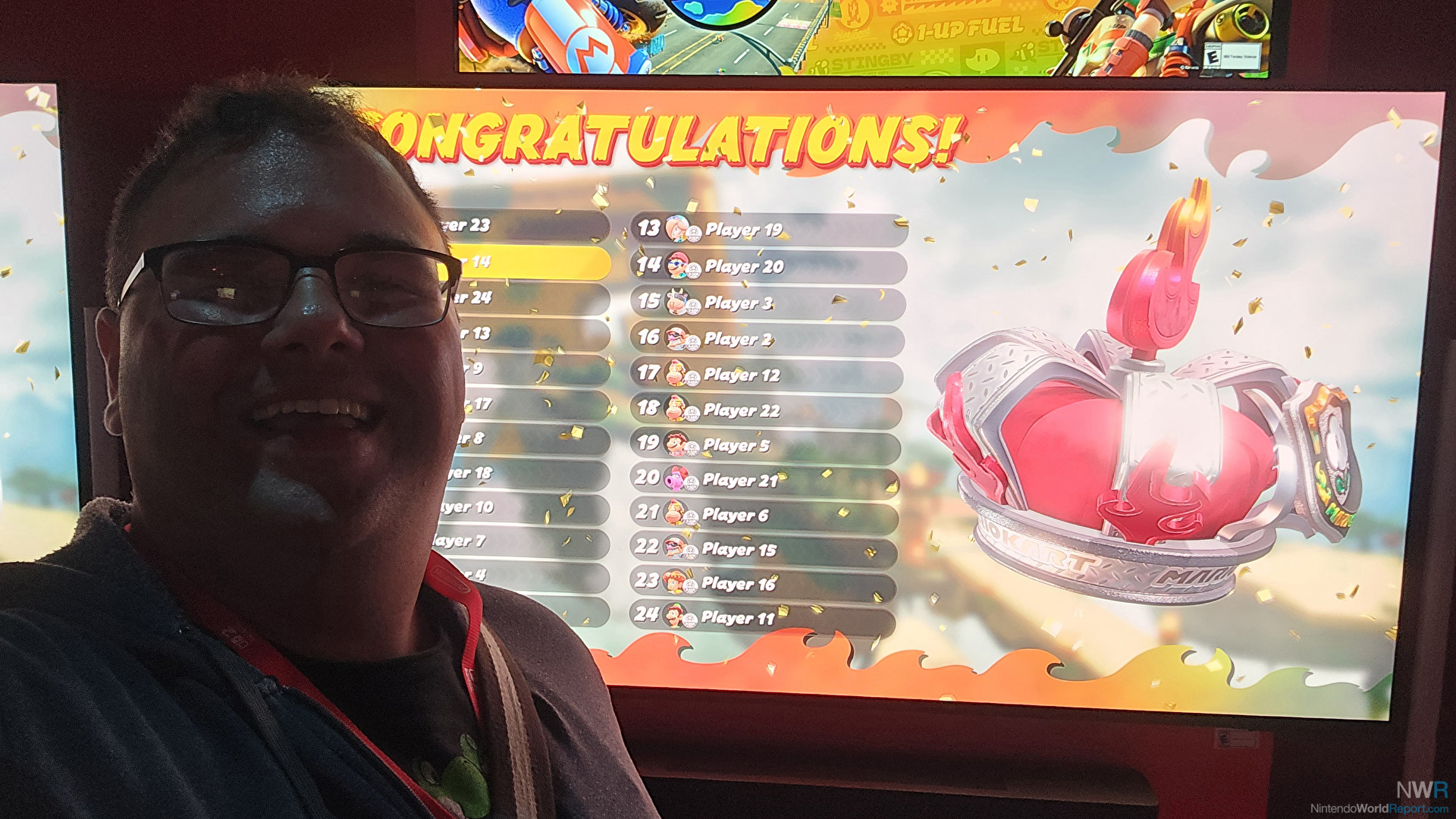
My Biker Bowser and Standard Bike combo continued to disappoint, but I somehow kept surviving. I found myself near last place for most of the race but was gifted good items near each checkpoint. At some point, I grabbed a glowing golden take-out bag. Through the power of food, Biker Bowser was transformed into Regular, Naked Bowser. When I asked my rep about the food power-ups, she just told me to watch the Mario Kart World Direct on the 17th. I placed second.
I did get a rush from the frantic jockeying and constant item spam. A ton of classics are here, like shells and fireballs, but getting hit no longer brings you to a full stop. The momentum never died out, both for my racer and my engagement. While World may look familiar, it is no mere Mario Kart 9. This is a retooling of everything under the series' hood.
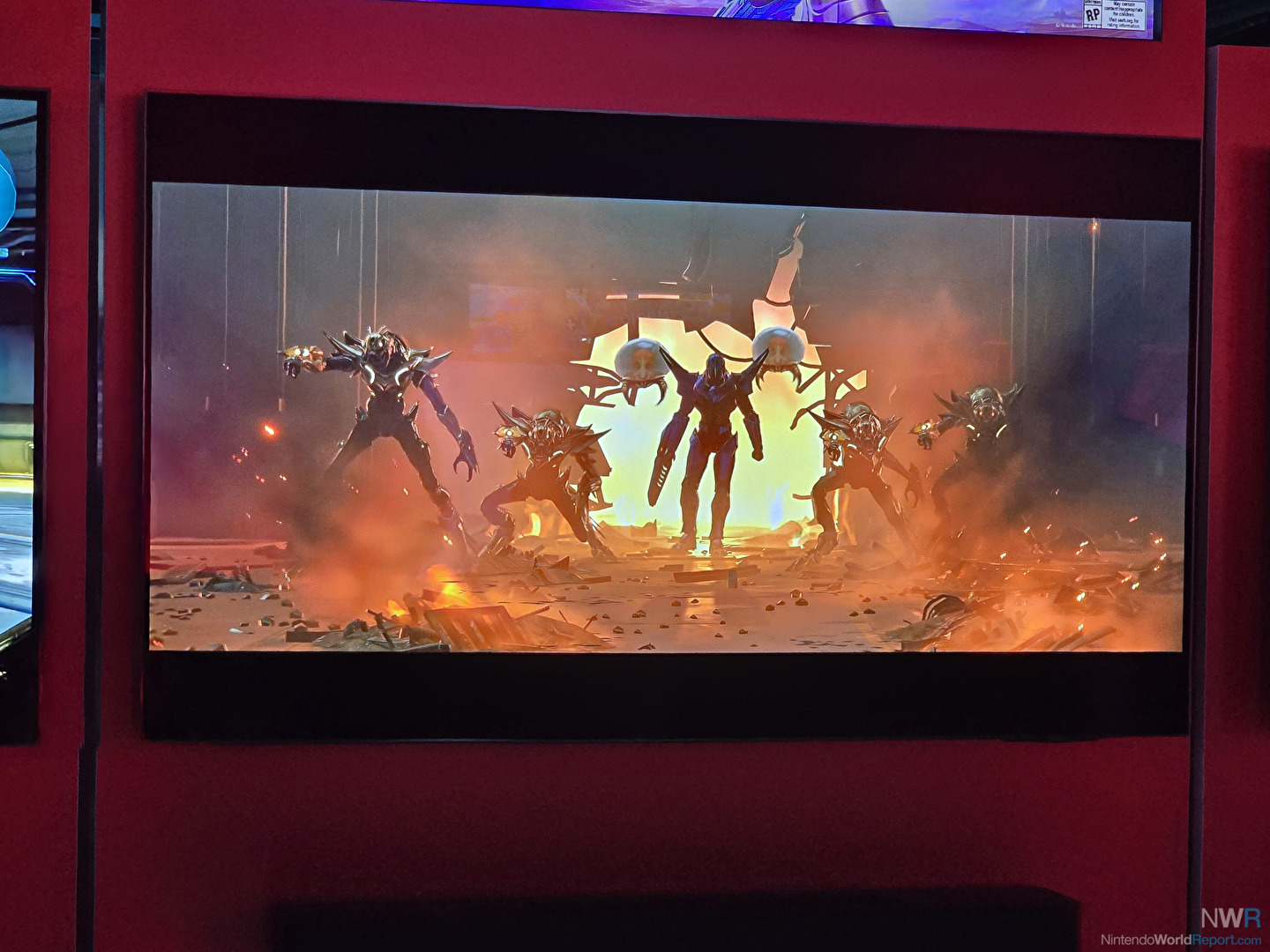
Metroid Prime 4 Beyond Nintendo Switch 2 Edition
The demo for Metroid Prime 4 Beyond was set to performance mode, 1080p and 120 fps, but I'm not cursed with the ability to perceive differences in higher frame rates. Prime 4 did look great, but I expected nothing less from the people behind the stunning Prime 1 remaster. I would've appreciated the option to play in 4k.
We were thrown into a somewhat gray firefight and invited to try out mouse-mode controls. By placing a Joy-Con 2 sideways on a surface, players can control the game like one would a PC game. I'm also not cursed with a mouse-and-keyboard preference, opting for a controller on PC, but mouse mode felt fantastic. Camera control maps to mouse movement, disabling your right stick. The rest of the buttons retain their normal functionality, mimicking a gaming mouse with mappable side buttons. ZL locks onto enemies, then you just click on them to shoot them. Click! Click! Click! No more Space Pirates. Lifting the Joy-Con 2 switches seamlessly back to split controller mode, which uses gyro motion controls for aiming.
This section was far too explosive to capture the essence of Metroid, but coming in after Dread and Prime Remastered, I don't doubt Prime 4 will offer deep exploration. We just didn't see that in this demo.
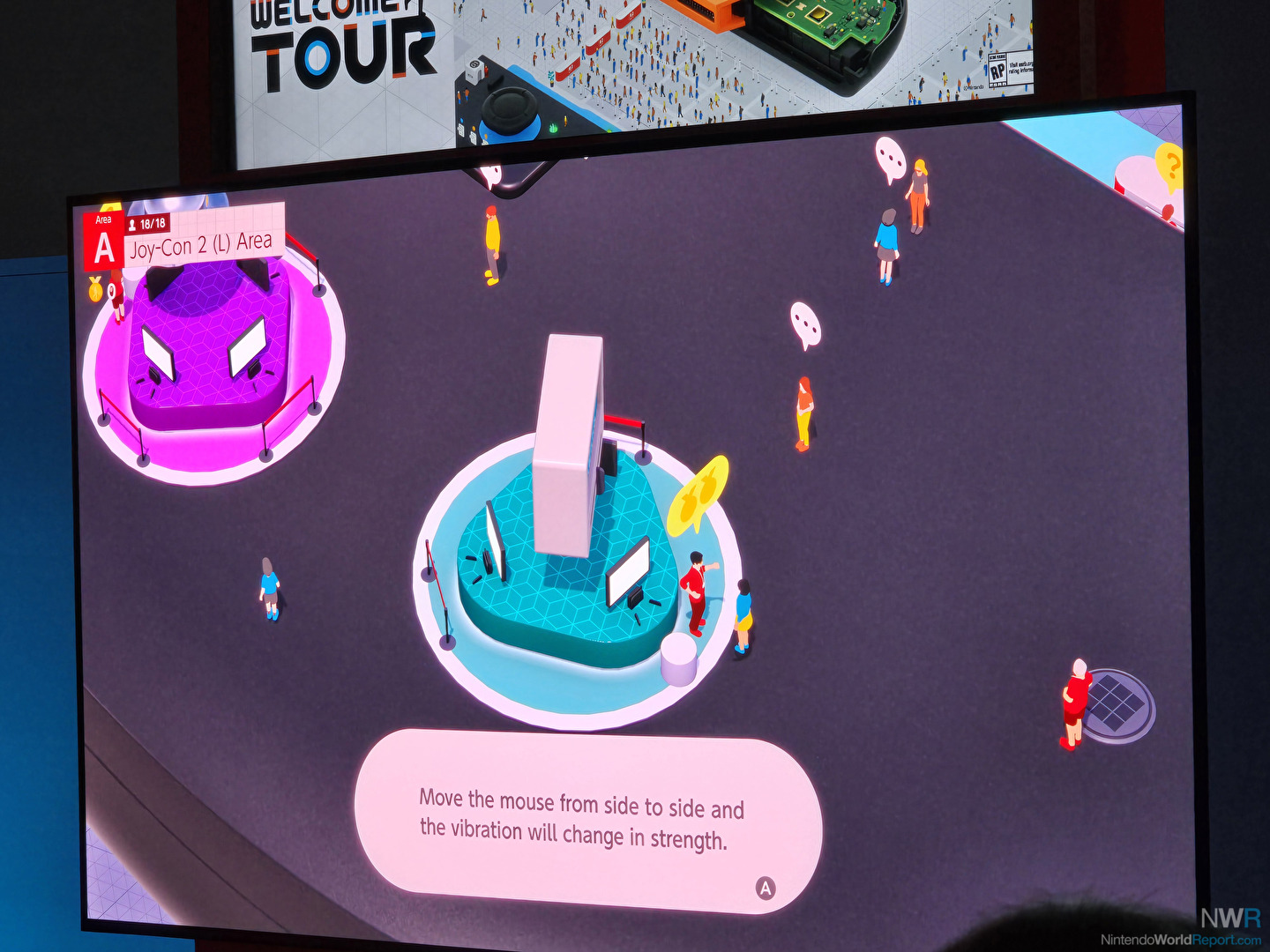
Nintendo Switch 2 Welcome Tour
A small, downloadable tech showcase, Nintendo Switch 2 Welcome Tour was written off by many at first, but one must never underestimate Nintendo Charm. For those who miss the whimsy of old Nintendo system menus, Welcome Tour lets you shrink down to explore the ins and outs of the new hardware. I love a good checklist, and Welcome Tour is an exercise in progression. By completing minigames, tech demos, and product knowledge quizzes, you unlock new areas and even more checklists to complete. I saw hints of character customization and the potential to go inside the system. While I doubt Welcome Tour will be well-remembered, it reminded me of long road trips with nothing but the 3DS's pre-installed apps. The fact it is a paid download gives me hope it has more depth than it looks like from the surface.
Drag X Drive
In Drag X Drive, a showcase for dual-mouse mode, players slide both Joy-Con 2 across a table to mimic using a wheelchair to play basketball. Each side controls a different wheel, so moving one more than the other turns the character. Smashing into someone who holds the ball knocks it out of their hands and bouncing down the court. Lifting and flicking the Joy-Con 2 shoots toward the basket, and direction and distance dictate how accurate the shot is. Lots of blacks and grays paired with stuttery character animations gave the whole game a tech-demo vibe.
We played one match of 3-on-3, all human players. I grasped the controls pretty quickly, but since each long slide of the controller required picking it up to bring it back towards you, I misaligned a ton of slides, making my character spin wildly in place. My team dominated the other 10-5, with me scoring most of the shots, so I can only assume the other players had similar struggles. A few slides shot pain down from my wrist to my elbow. I'll be sitting this one out.
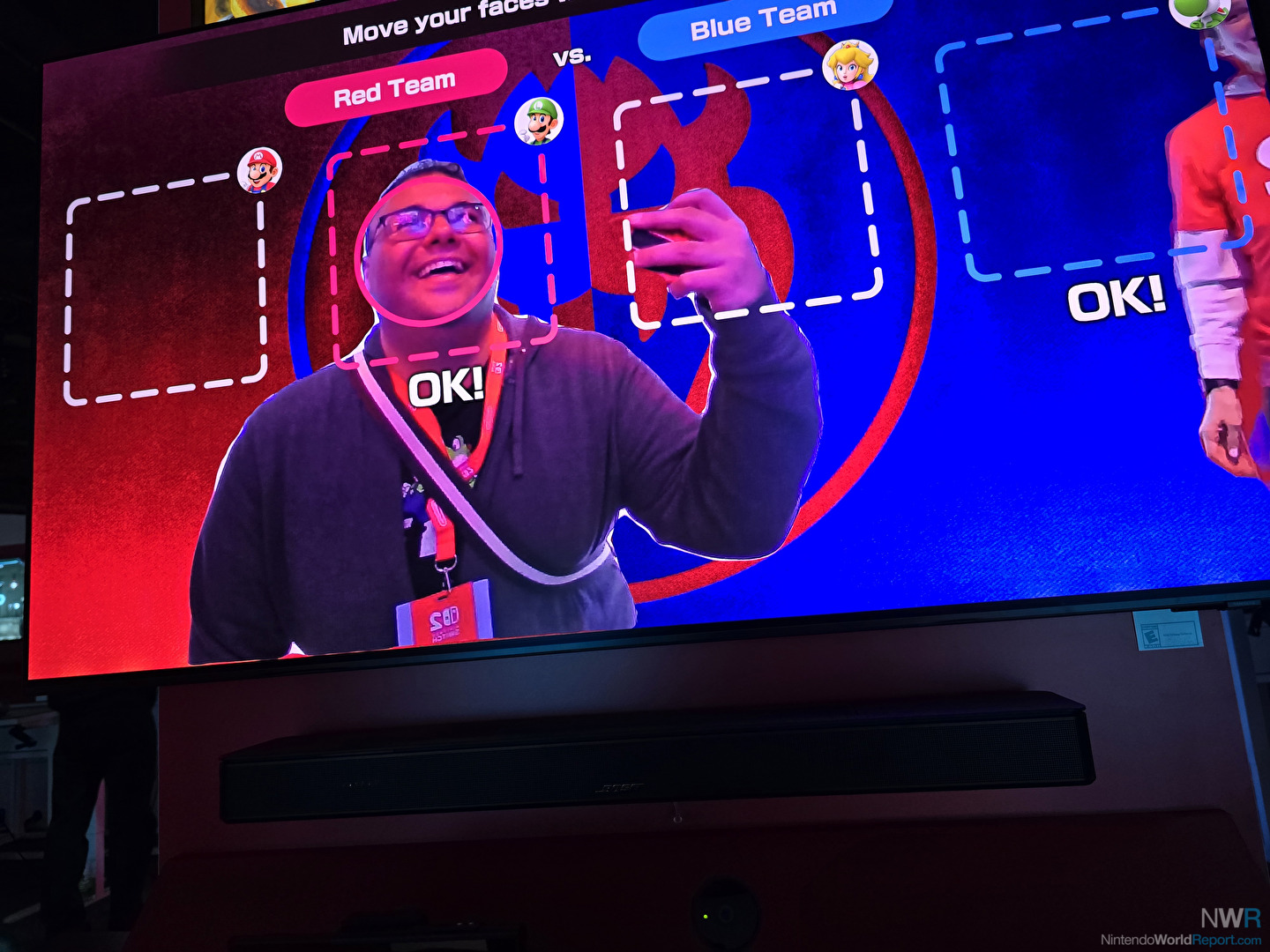
Mario Party Jamboree Nintendo Switch 2 Edition + Jamboree TV
Mario Party Jamboree is getting paid DLC for Switch 2 that takes advantage of the new hardware. I played camera minigames in Bowser Live and some mouse-mode minigames. I missed the Jamboree TV announcement and literally laughed out loud when I saw myself standing in a crowd of Mario enemies, cropped from a live Nintendo Switch 2 Camera feed. The minigames were nothing to write home about, balancing Goombas on your head and punching a coin block, but they were cute enough for kiddos. The third minigame, jumping around and screaming as loud as you can, is sure to be a hit.
The mouse games were quite a bit more polished, air hockey and a don't-touch-the-edge maze game. I'm not sure if these are added to the regular rotation of minigames, but I liked them enough to be excited for the next Mario Party.
Donkey Kong Bananza
After an hour or so of free play, we were moved into the Donkey Kong Bananza demo room. In this new 3D collect-a-thon, miner Donkey Kong digs and smashes through almost everything in the environment in search of Golden Bananas. Punching walls felt a little slow, but ripping a chunk out of the wall, then smashing it back into the wall made quick work of digging tunnels. Different materials have different durability, and some even explode when thrown.
Although the entire adventure takes place underground, our demo level was a bright, floating island with loads to explore. My rep showed me multiple paths to get to the end of the demo, each with different collectibles. The 3D map reflects DK's destruction through the level, so it's easy to remember where he's been.
The rep was super chatty until I asked about this character leaked by Nintendo South Korea during the event. He assured me it was photoshopped.
Other games
Kirby and the Forgotten Land Nintendo Switch 2 Edition + Star-Crossed World had a line as long as its title, so I didn't get to play it. I didn't think the original's crisp, vibrant world could look any better without a big change in art style, but HDR gives that game a huge boost. It was also the only station with the Joy-Con 2 Grip, the one thing I regret not trying.
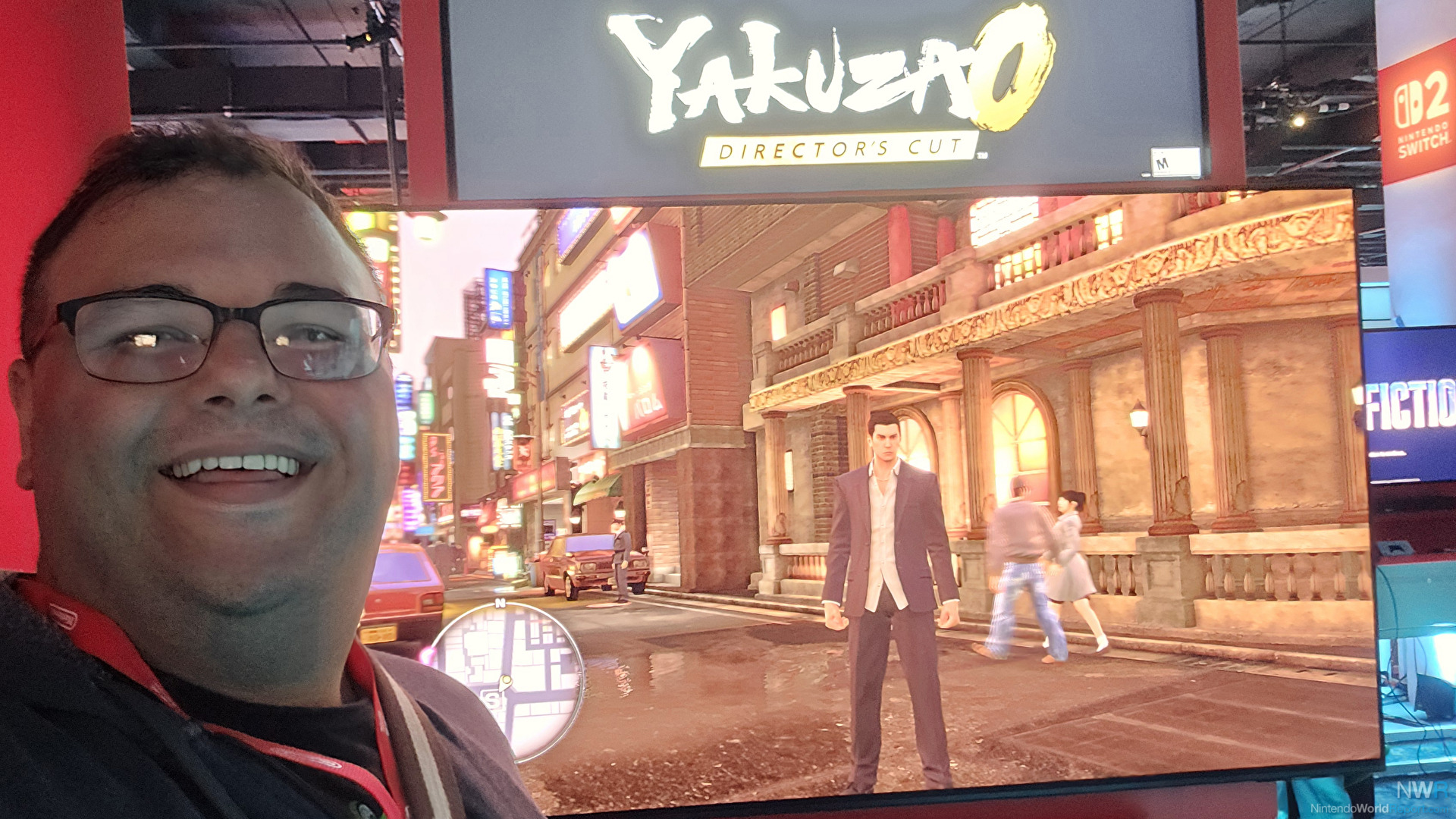
Yakuza 0 Director's Cut, an open-world crime game set in 80's Japan, is a great game but certainly didn't look better than I remembered on PS4. And I don't remember it looking great on PS4.
Cyberpunk 2077, a sci-fi first person sandbox, looked beautiful in motion, if not a bit motion-blurry.
I tried to play Street Fighter 6 to test the D-pad but accidentally signed up to play with motion controls. You use one sideways Joy-Con and tilt to move to either side and shake to attack. We didn't know what was going on.
The Legend of Zelda: Breath of the Wind and Tears of the Kingdom deserve the Nintendo Switch 2 Edition upgrade more than any other game here. While I didn't get to play it myself, I did stand in line for it, awestruck by its beauty. I think it's a little light on content to justify a replay, but it's a free upgrade for Nintendo Switch Online + Expansion Pass subscribers.
GameCube games on Nintendo Switch Online are perfect, as is the new GameCube controller. Rejoice.
Conclusion Nintendo Switch 2 Edition
I don't have $500 laying around right now and tried so hard to convince myself I didn't need a Switch 2 at launch. Nintendo undid that today. I may need grips or a third-party controller, but the Switch 2 impressed me. My only big questions are battery life, Holiday lineup, and if they're hiring.
As I stepped out of the world of Nintendo and back onto the streets of New York, I was greeted by the largest protest I have ever seen. I, too, am mad that preorders were delayed due to sweeping new tariffs. Gamers, rise up. I need the Switch 2 now.
Five new Zelda amiibo were announced by Nintendo today shortly after the Direct. Tears of the Kingdom companions Tulin, Yunobo, Sidon, and Riju will get amiibo June 5th, the same day the Switch 2 releases, and Mineru's Construct will release as an amiibo on a later date. When scanned in Tears of the Kingdom, they "might" grant a paraglider fabric.
Street Fighter 6 will come to Switch 2 at launch with three amiibo figures and 22 amiibo cards. Players can save outfits and button settings to the amiibo or send friend requests with a tap. Terry, a guests character from Fatal Fury, will not get a new amiibo, and his Smash Bros. amiibo is not listed as compatible on Street Fighter's website.
Final Fantasy VII Remake Intergrade is in development at Square Enix for Switch 2. Director Naoki Hamaguchi also asked players to "look forward to more updates on the Final Fantasy VII remake project for Switch 2."
The remake project is a series of action-RPG reimaginings of 90's turn-based classic Final Fantasy VII. Remake Intergrade expands the original's opening act in the city of Midgar and introduces Intermission, a parallel side-story starring the ninja Yuffie.
Other titles in the project include Crisis Core Reunion (a side story already available on the original Switch), two mobile games, Final Fantasy VII Rebirth, and an unnamed third core title in development.
Nintendo Switch 2: Welcome Tour, a paid, playable tutorial minigame collection, launches June 5th.
The digital-only game explores features of the Switch 2, such as mouse mode, HD Rumble 2, and the microphone. Tech demos and minigames shown include golf, a UFO game, and maracas.
Silksong, follow-up to beloved 2017 indie game Hollow Knight, appeared in today's Nintendo Switch 2 Direct with a 2025 release date.
Hornet, a nuisance-turned-ally from the original Hollow Knight, stars in this spin-off adventure that was originally planned as paid DLC. Silksong was upgraded to a stand-alone game in 2019.
Koei Tecmo returns for Hyrule Warriors: Age of Imprisonment, a musou game set in the far past of The Legend of Zelda: Tears of the Kingdom.
The Imprisoning War took place "long ago" in the Hyrule of Breath of the Wild and Tears of the Kingdom, and Age of Imprisonment's story leads directly into that of Tears of the Kingdom.
Hyrule Warriors: Age of Imprisonment launches this winter.
The mysterious C-button on the Switch 2 JoyCon launches GameChat, Nintendo announced in today's Direct.
GameChat uses a noise-cancelling mic on top of the system, even when docked. Chat members appear at the bottom of the screen under a slightly shrunken game window. Players do not need to be playing the same game and can stream their screens to each other.
With a Switch 2 Camera, a webcam launching alongside the system, players can stream their face over their gameplay with the background automatically removed. Some games, such as an upgraded Mario Party Jamboree, can replace a player's in-game icon with a live facecam.
An active Nintendo Switch Online account is required, and players with Parental Controls must request permission to join each voice chat. Nintendo Switch Online GameChat will have a free trial until March 31, 2026.
Xenoblade Chronicles X is escaping Wii U captivity in the form of Xenoblade Chronicles X: Definitive Edition. This remastered version features improved graphics, higher resolution rendering, quality of life updates, and a fair amount of new content. But if it is your first time venturing to the distant world of Mira, we've assembled a few frequently asked questions you might be asking as you debate picking this game up.
Q: Does Xenoblade Chronicles X: Definitive Edition add new content not included in the original release of Xenoblade Chronicles X.
A: Yes, it includes new characters, skells (mechs), new story content, and a new area of the map.
Q: Can I play the additional story content without playing the rest of the game.
A: While there are some new characters and content throughought the game, the new zone and story chapter can only be accessed by first finishing the base game.
Q: Should I play the other Xenoblade games first?
A: Xenoblade Chronicles X was originally released as the second Xenoblade game and had minimal overt ties to the original game. The story of Xenoblade Chronicles X can be experienced with no prior knowledge of the franchise
Q: If I buy Xenoblade Chronicles X: Definitive Edition physically can it run entirely off of the cartridge or are additional downloads required?
A: No content download is required, though downloading any available patches may potentially improve game performance.
Q: How long is Xenoblade Chronicles X: Definitive Edition?
A: While it is possible to rush through in about 60 hours, most playthroughs will be between 80 and 100 hours
Q: Has Xenoblade Chronicles X: Definitive Edition been censored outside of Japan?
A: Not technically, the content of the Definitive Edition version is the same between the Japanese and western releases. However, it is built off of the western release of the original Xenoblade Chronicles X, which bundled the Japanese DLC content into the base game. The original western release also updated some outfits for underage characters to make them less provocative and removed a chest size slider from the character customization menu. The Definitive Edition preserves these western updates in all regions including Japan.
Q: Does Xenoblade Chronicles X: Definitive Edition have multiplayer support?
A: Yes it includes both indirect online multiplayer in which players co-operate to accomplish large scale goals, as well as direct multiplayer where four players co-operate to take on powerful enemies in pre-determined missions. You can also share and recruit avatars from other players to join your party.
Q: Can I re-customize my character in Xenoblade Chronicles X: Definitive Edition?
A: Yes, though you'll have to meet certain requirements first. Editing your character does not become available until you complete Chapter 5 of the main story as well as the quests "Yardley's Scheme" and "House of Cards".
Want to know more about Xenoblade Chronicles X? We've got plenty of great content reaching all the way back to its original release on Wii U.
Pokemon Go was designed to be played while doing something else. Niantic’s augmented reality geolocation games are explicitly meant to draw players to areas of interest in their local communities, but parks and outdoor art exhibits are hard to appreciate while staring at a phone. The “Plus” line of companion devices aims to fix that, with some success. The latest device, the Pokemon Go Plus +, might have the hardest-to-Google product name ever but earns all those plusses – alongside one big minus.
Those familiar with the original Pokemon Go Plus or the Poke Ball Plus know the basics: the Plus + connects to Pokemon Go to light up and vibrate when a Pokemon or Poke Stop is nearby. The big button on the front throws a single Poke Ball or spins the Poke Stop to collect items. New here is the option to throw a Great or Ultra Ball for a better chance at catching Pokemon or auto-throw basic Poke Balls without pressing a thing, alongside auto-spin of Poke Stops. Allegedly.
When the Plus + works, it’s incredible. The auto-throw feature bounces quickly between Pokemon with a satisfying buzz, the new Bluetooth Low Energy standard killing all lag. A sleepy Pikachu lives inside and calls out as the Plus + connects, disconnects, or finds a Pokemon the player hasn’t caught yet. However, the auto-throw and auto-spin modes are just plain broken. Only some secret, magical combination of app cache clears, device reconnects, and Bluetooth setting toggles activates the auto modes, and only then for less than an hour. All Plus devices disconnect themselves around the hour mark, but the original Plus and Poke Ball Plus reconnect with no fuss. While the Plus + does reconnect quickly, it almost always defaults to manual mode, prompting the troubleshoot tango outlined above as Pikachu calls out in glee every other step of the way. Pikachu can be silenced via the menu or the device itself, but its surprising number of voice clips are pretty darn cute.
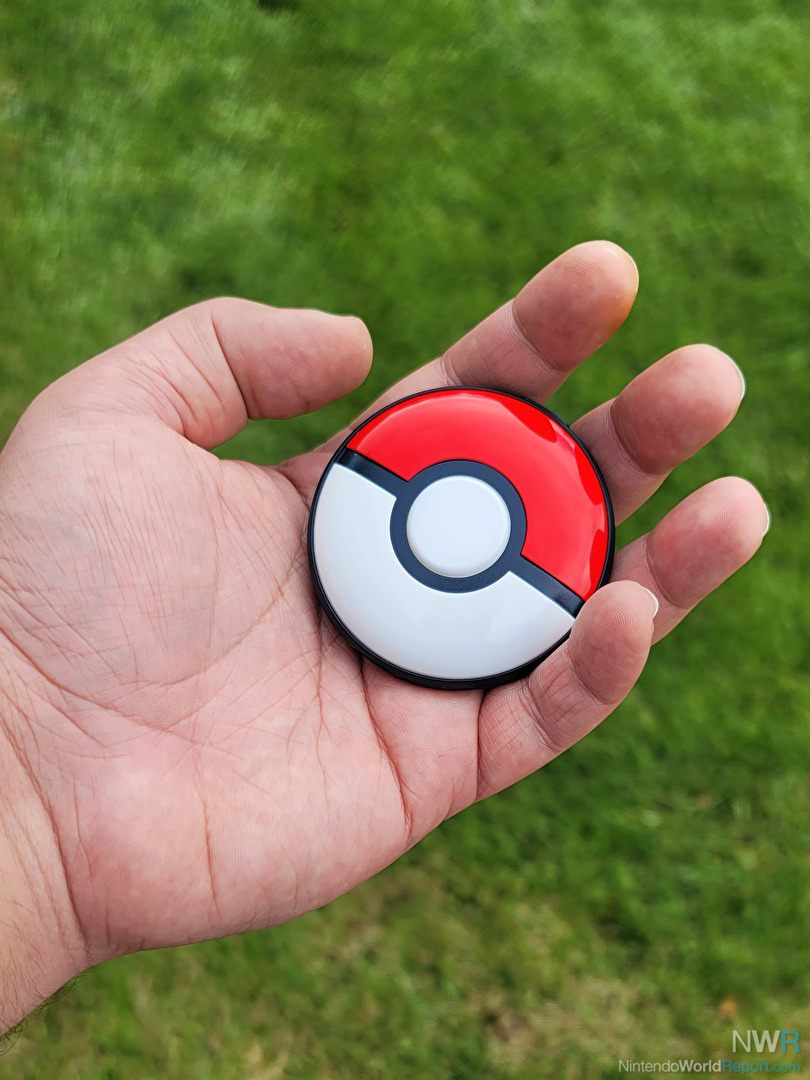
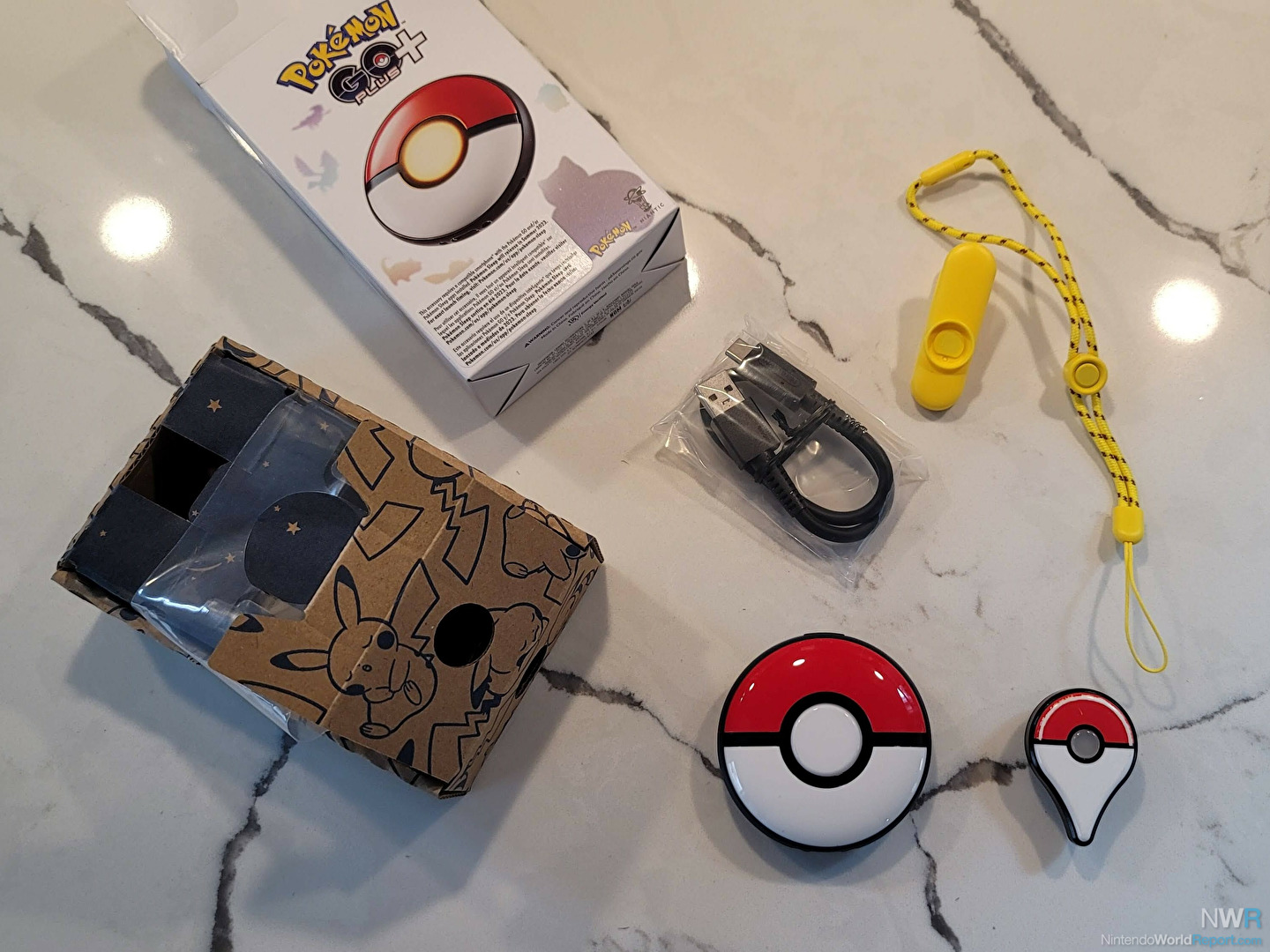
As a tactile device, the Plus + is beautifully crafted. Its soft black plastic back is as smooth as the neatest rock, and the glossy red-and-white front sports a grooved black line down the center perfect to run a thumb across. The large, illuminated center button gives a satisfying click. The vibration is strong enough to feel in a pocket and seems almost organic in the palm, while flashing rainbow lights punctuate successful game actions with a captivating, short-lived glow. To nail the vibration and lights implementation on the Plus + was important as neither feature can be disabled. The Plus + feels great to mindlessly spin around in fidgety hands, but less so with the included wrist strap attached.
This magnetic wrist strap connects to a pillow clip for the Plus +’s most baffling feature: sleep tracking. Pokemon Go and the new Pokemon Sleep let players catch Pokemon and Z’s at the same time by monitoring bedtime movement and noise, and the Plus + can sub in for a player’s phone to track sleep. The Plus + is not at all necessary for Pokemon Sleep (especially not with its bright amber charging LED right next to your face) but it does let sleepy Pikachu join Pokemon Sleep, complete with nightcap. Sleep mode activates after a short hold of the Plus +’s center button, and a lullaby from Pikachu, but only counts after 90 minutes. It activated itself a few times in my pocket throughout the day.
Aside from the unforgivable auto-mode glitch, the Plus + is a solid addition to the Plus device line but fails to address issues with the line itself. A Plus fundamentally changes how Pokemon Go is played but punishes the player for these changes. The Plus line’s quantity-over-quality gameplay style quickly fills players’ Pokemon storage and depletes their Poke Ball supply. Both can be remedied through microtransactions, but that feels like a weird solution to problems created by a device that costs as much as a full, mainline Pokemon title. Pokemon are always prioritized over Poke Stops unless catching Pokemon is completely turned off in the settings.
The Plus + is also just massive. The original Plus was the perfect size to forget at the bottom of a bag or pocket until needed, but pocketing the Plus + feels like an intention. A battery rechargable via USB-C is a welcome addition, but auto-mode and sleep tracking, so far, are harder to recommend.
Splatoon is almost old enough to kick your inksac in an online match, but the third entry aims to help the series stay fresh. At a recent press event, the Squid Research Lab took us through what’s new in Splatoon 3.
A lot feels familiar, even to a more casual player (like me) who never dived into the depths of the first two Splatoons. Turf War is still the main draw: two teams of four shoot, slosh, and spray ink across a battlefield to cover as much of the stage as possible in their team color. While not the focus, “Splatting” opponents with your weapon sends them all the way back to start, which now hovers above the air. It’s a small change, but the new spawn point gives a great view of the game state and lets the player choose which direction to take off in.
We saw two new stages: Scorch Gorge and Eeltail Alley. Both are long and narrow with plenty of nooks and crannies to paint. Scorch Gorge has interesting inclines and a tower in the middle. Grate bridges leave players vulnerable from below but lead right to the tower. Eeltail Alley’s solid bridge over the center of the stage adds depth to the turf war and a second infiltration point into enemy territory. Splatoon 3 will launch with 12 battle maps in total: five of which are new and seven that return from previous games. Maps rotate every two hours.
Multiplayer has some nice additions outside of matches, too. Players now chill in a training room lobby with holograms of other players. Here, competitors can change and test out weapons or watch opponents for insight into their playstyle. Teams traditionally get shuffled between bouts, but if a player groups up with friends before entering the lobby, that team will always stay together.
Wave-based Salmon Run has dropped its weird schedule from Splatoon 2 and is now available anytime. In Salmon Run, a team of four players harvests salmon eggs from the dingiest part of the ocean by splatting waves of enemies accompanied by a miniboss. The tide ebbs and flows between waves, constricting your team’s control or exposing new areas. Weapons are assigned at random, pushing players out of their comfort zone, and difficulty scales with ability. Players can now throw eggs across the stage to their basket if they have enough ink, which felt great in the middle of a firefight.
The final mode we saw was Return of the Mammalians, Splatoon 3’s story mode. Levels start as they did in Splatoon 2’s Octo Expansion DLC, in a little test room with a weapon select screen. Agent 3, the main character, spends points to pass through a turnstile and enter the level. In the first two levels we played, Agent 3’s secondary weapon was replaced by Small Fry, an allegedly important story character that Agent 3 can throw at enemies to slow them down. The story sees Agent 3 and friends investigate a mysterious new fuzzy ooze, but we saw neither cutscenes nor fuzzy ooze in our demo.
During the preview event, we spent time with two new weapons as well. The Tri-stringer is a bow that fires three arrows, horizontally if on the ground or vertically if in the air. It can be charged up to focus the shot and leave small ink bombs on its target. We also tried the Splatana, a windshield wiper full of ink. The Splatana has quick, wide horizontal attacks and a long, narrow vertical charge shot, great for inking and Splatting, respectively. As for new specials, I rode the new Reefslider through a wave of enemies and directly into the ocean. This special summons an inflatable orca that charges in a straight line, then ink-splodes at the press of a button. I dodged the initial dash a few times but was always too slow to avoid enemy ink-splosions. I also tried the weird new Tacticooler special, a vending machine that gives each passing team member an energy drink. The cephalopods get a few new movement options, too: a charged jump up walls and a shielded backflip for quick retreats.
Splatoon 2 veterans will see some benefits from importing their save data, like a way to quickly unlock favorite weapons and matches against players of comparable skill. And of course, the Splatooniverse is all about style, so Splatoon 3 brings new ways to customize characters. Inklings and Octolings are both playable from the start. Players choose an emote for the battle results screen and win medals based on game stats, like area inked. We didn’t get to peek in any shops or the new decoratable lockers, but seasonal catalogs promise to keep a steady stream of new swag flowing into Splatsville for two years after launch.
While not part of our demo, Splatoon 3 introduces new 3-way Splatfest competitions where three teams battle on the same map. The first Splatfest acts as a free demo for all Nintendo Switch Online subscribers August 27 from 9 a.m. to 9 p.m. PT. Splatoon 3 launches in full September 9.
I'm glad you liked it, too! I don't actually think I remembered who was that frustrating when I looked back at my notes which is why I put it that way. Funnily enough that part is on the Hollow Knight Wikipedia page lol. When I came back to Hollow Knight I was so rusty I couldn't even navigate the first area anymore, so no, I have not gotten the full ending or done any DLC stuff, but I have seen all of mossbag's videos! I don't *really* love review scores, but I believe the review I wrote was for a 10/10 game and stand by my review
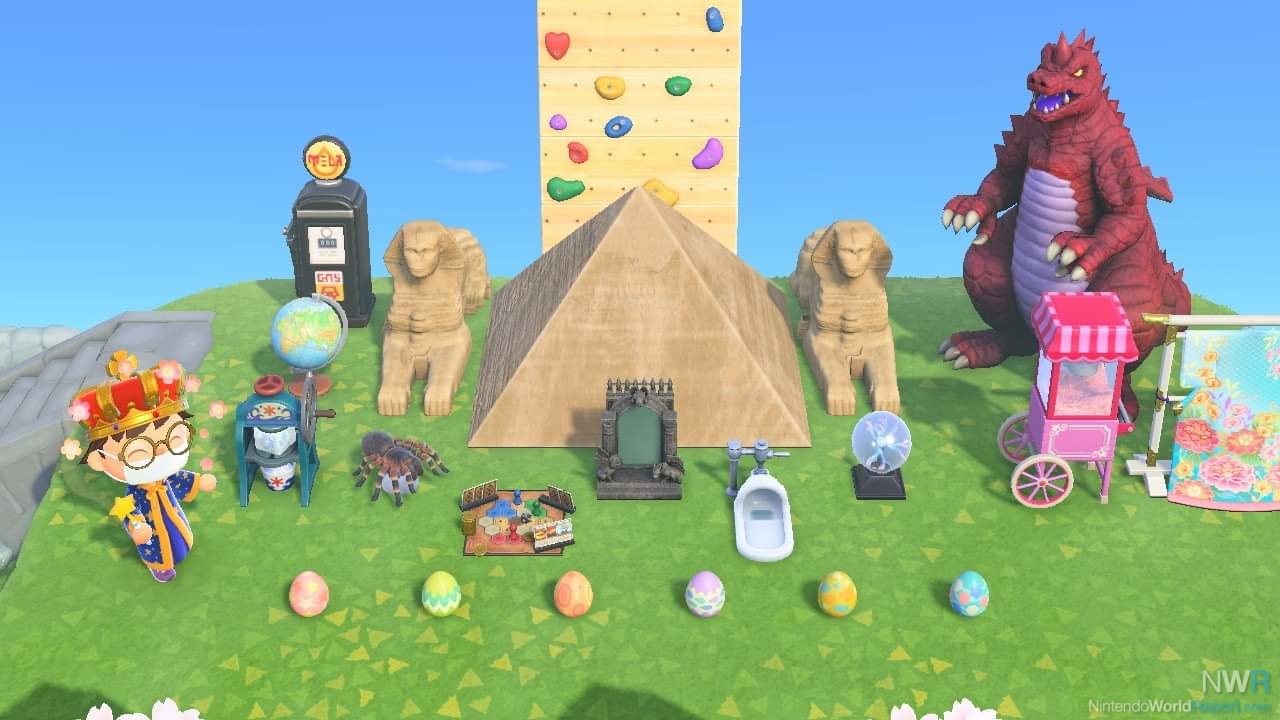
So, I think I beat Animal Crossing. I paid off my house after my windfall in the Twitter turnip market, decorated my town, and bought enough inclines and bridges to put San Francisco to shame. I still find myself spending hours wandering my town, bothering neighbors and rearranging trees, but a deep emptiness hides behind my villager's bee-stung eyes. What does it long for?
Perhaps quarantine and the new Dodo Code system broke Animal Crossing's slow pace. New Horizons already set sales records and is partly responsible for a global Switch shortage. Everyone is playing this game, and they're all posting new discoveries online. I can travel across the world in an instant to collect cool furniture and outfits, something my own town seems to be lacking.
My still tiny and unexpanded shop has gone three days without a single new item for sale. Instead, I find new color variations of stuff I already have. New Horizons leans heavily on a new crafting and customization mechanic to let creative folk decorate to their exact tastes, but a bit of excitement is lost when every island I visit has different colors of the same ironwood furniture set.
In past Animal Crossing games, I spent most of my time on the hunt for the modern furniture set. Its black and grey color scheme and sharp corners made me feel like an East-coast bachelor with a job in finance. Dozens of furniture sets gave players tons of options to mix and match. Sets are gone, including the highly coveted Nintendo series full of fun nods to other franchises.
New Horizons' crafting system slowly doles out recipes for new items. Players can find one on the beach each day, learn one from a crafting villager, and potentially find more floating in a balloon above the island. Just three weeks after launch, I have a handful of worthless duplicate recipes. Animal Crossing is a series about finding new things every day, but I feel I'm out of new discoveries.
Nintendo has promised ongoing updates for New Horizons, and its stellar sales all but guarantee years of steady content. I wonder if I'll still be playing. The Bunny Day event for Easter was best experienced through the deluge of memes on Twitter, and I’d seen most of the new content before I’d even booted my Switch for the day. While we don't know how substantial future updates may be, Animal Crossing demands near-daily attention to maintain interest. Will I just pop in to future events for a day or two to maintain my feeling of completion? Will I fall down the slippery slope of using the miss of one event to justify the skip of the next? Will I just see a data dump on Twitter and move on?
Animal Crossing may never recapture that element of surprise. Endless guides detail min-maxing daily routines from how many items hide in trees to how to optimize rock-farming techniques. These series mainstays felt like earned knowledge in earlier games, but I don't know that future updates can maintain their mystery for long.
One might think bells, the fictional currency of Animal Crossing, make the world go 'round. Everything from house upgrades to new outfits cost bells, but a secretive class above us trades turnips. Yes, yes, Tom Nook certainly financed his recent private island acquisition with gains on the stalk market. On one lucky day, I amassed myself a small fortune, too.
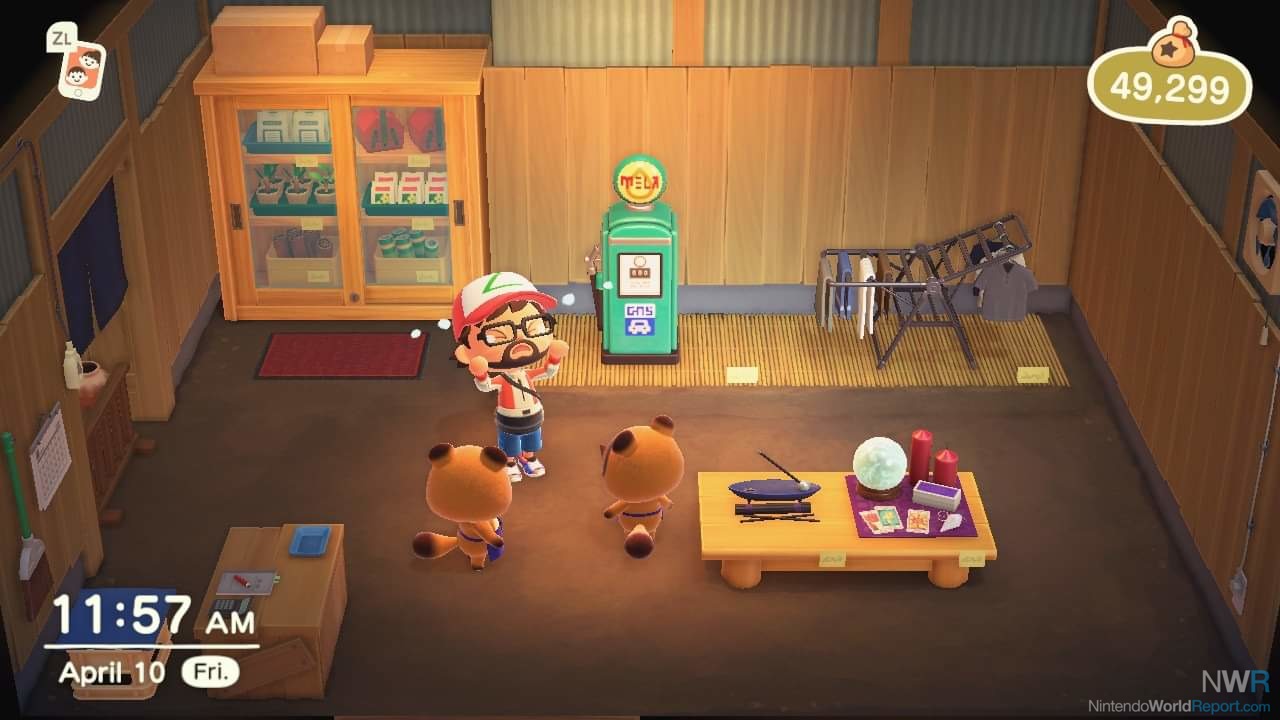
On Sunday mornings, New Horizons newcomer Daisy Mae sells turnips for about 100 bells each. Shopkeepers Timmy and Tommy Nook buy turnips every other day of the week for a random price, with a price change at noon. Turnips spoil in one week. I was disappointed to find the Nooks offering 84 bells a turnip after I had poured my savings into 96-bell turnips just days before. I took to Twitter in search of a better price.
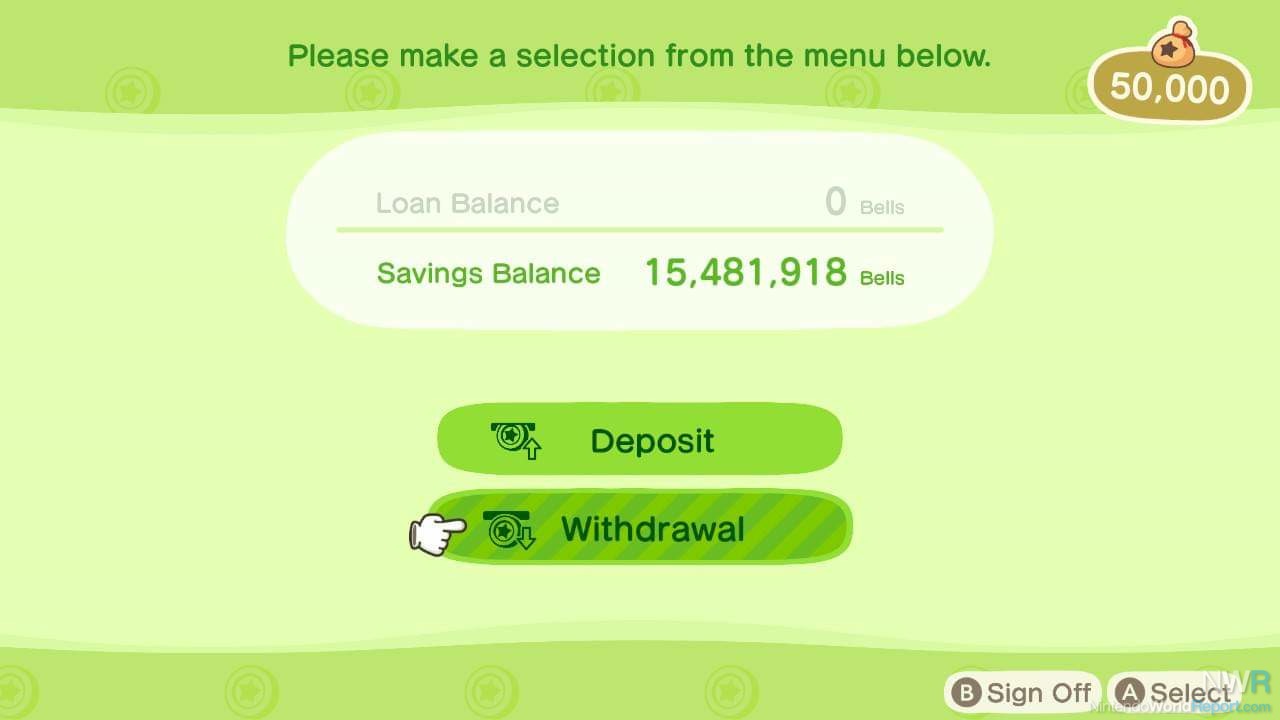
Twitter user @PaoloLejano had a price of 618 bells per turnip and let me make a few trips. I sold through my stock and left about half my profits as thanks. In just a few minutes, I had more than 4 million bells in my bank account and had paid off my final house upgrade. I didn't think life on my island could get any better.
I awoke to find my town infested with eggs. The Bunny Day update brought a terrifying Easter bunny and a boring questline, but the cherry blossoms balanced my annoyance. I prepared for a quiet, beautiful day. At noon, I checked my turnip prices out of curiosity: a whopping 544 bells. I shared a screenshot online and dropped my price in the NWR Discord. When one member assumed it was an April Fool's prank, I knew this was a big deal.
I was inundated with requests to visit my island. Most players request tips for their trouble, but I was set on bells, so I just asked for an interesting item. I left “interesting” up to interpretation. I used the new Dodo Code system to quickly invite strangers to my game without the need to swap Friend Codes.
Then, the nightmare began. Each time a visitor lands on your island, all players freeze in place for a load screen. The length varies with internet strength, but it's too long with even a great connection. Users with extremely poor internet would crash the session for all players and deactivate the previous Dodo Code. At times, we'd sit through minutes of back-to-back load screens before anyone could take more than a step.
Nevertheless, everyone I played with was grateful and gracious. I interacted with more than 100 Animal Crossing players in just one day, each more kind than the one before. No one took their frustration with disconnects or load times out on me. No one spammed the in-game chat or trolled. No one stole a thing.
A few players asked to make multiple trips. I assume some of them had set their own clocks to Sunday to create an infinite loop, but they were considerate and always asked before returning. The items I received certainly were interesting, although lots of players still left bells. I now have a wizard's robe, a train set, and enough eggs to feed the whole island.
By the end of the day, I was exhausted, like I had just finished a holiday shift at the mall. I also felt great. Some mix of the stress, accomplishment, and just plain human interaction left me beaming. I don't know that I've ever gotten this much out of an online game before.
I might not have any more turnips to sell this week, but I'm absolutely keeping an eye on the stalk market. Today, my shop is buying turnips for just 54 bells. I'm a bit grateful.
Divinity: Original Sin II Definitive Edition is a commitment. It’s an open-world RPG with deep, challenging, grueling turn-based strategy battles. Character customization is nearly limitless, but every choice matters, and the complete lack of explanation punished me for dozens of hours. The rich tapestry of lore and subplots is a satisfying reward reserved only for those willing to dig deep into old-school tabletop mechanics.
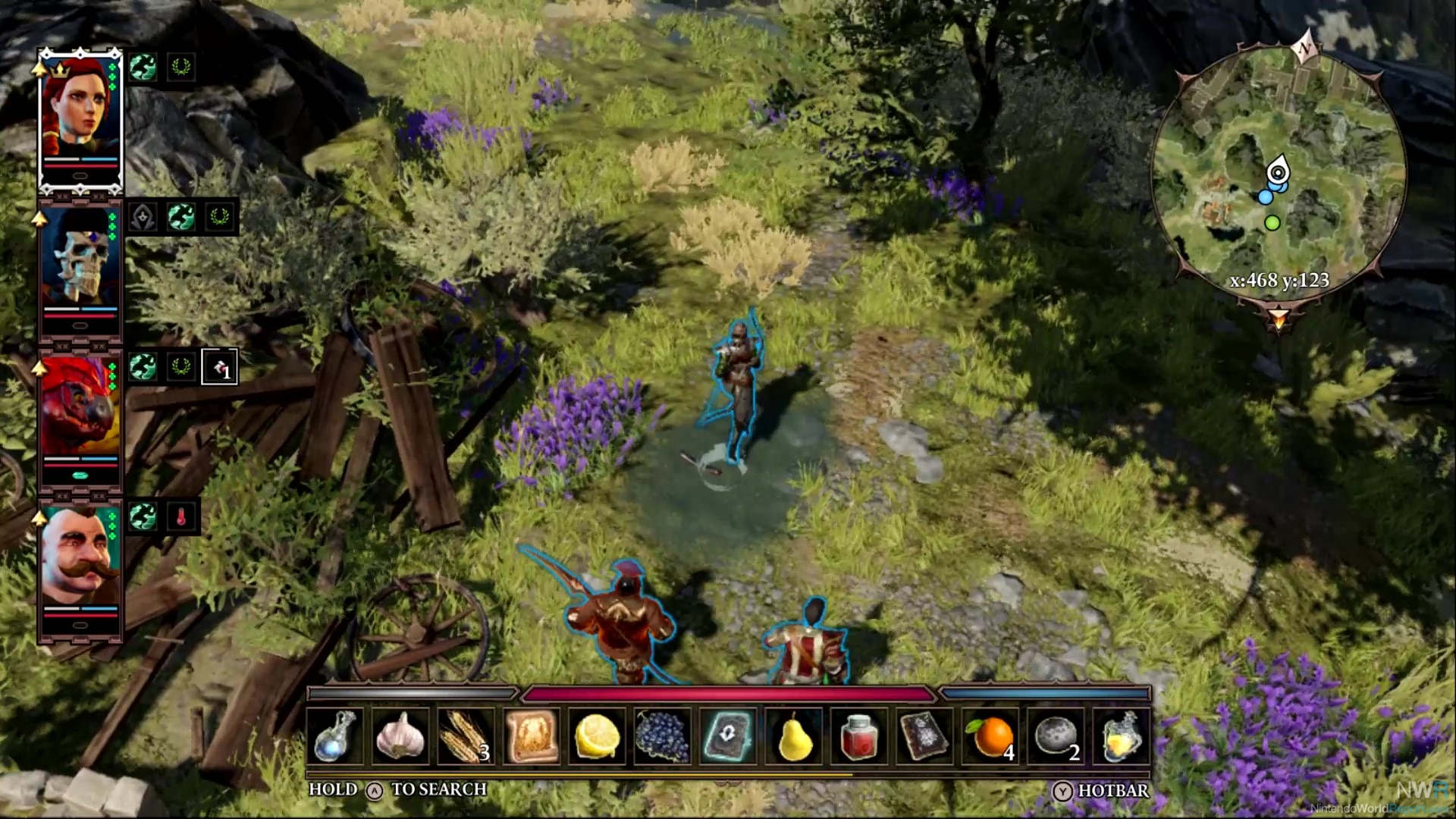
I started my adventure as Lohse, a cheeky bard with a demon perched on the edge of her psyche. Each of the six provided characters offers a unique backstory and path through the world. Custom characters give even more flexibility. Lohse woke up on a ship with a collar muting her Source, powerful magic rumored to attract dark beasts from the void. I put a bucket on Lohse's head as her first helmet.
Soon enough, Lohse and the others found themselves stranded on Fort Joy, a prison for Sourcers. I was immediately overwhelmed. I teamed up with three other Sourcerers: Beast, a dwarf on a quest to kill his queen; Fane, a skeleton who was locked away when the previous world collapsed; and The Red Prince, a compassionate royal lizard destined to rule the world. We crept into town and accidentally got into a fight with a group of card players. Dialogue options are realistic and varied, but that leaves them unpredictable. We barely scraped through.
I spent the next few hours on quests for townspeople. I was surprised by just how unique each was; I found no fetch quests or random battles. Every encounter in Divinity is handcrafted around its environment, and NPC quests are so entangled that I had to think about who to fight or risk closing other quests early. Some stories have no answer, like the woman looking for her child who isn't even in the game world, adding to the bleakness of the void's destruction.
As I worked to escape Fort Joy, I came across a battle that always started with a fire grenade and ended in my death. I needed a new approach. I found a water barrel outside and dragged it into the dungeon to counter the fire, and an online stranger took control of The Red Prince. She relied heavily on defensive spells, something I never use in other games. Friends and randos can take control of a character and travel the world independently, but any progress is locked to the host’s save file. I turned off multiplayer when my new friend died and tried to take control of Lohse.
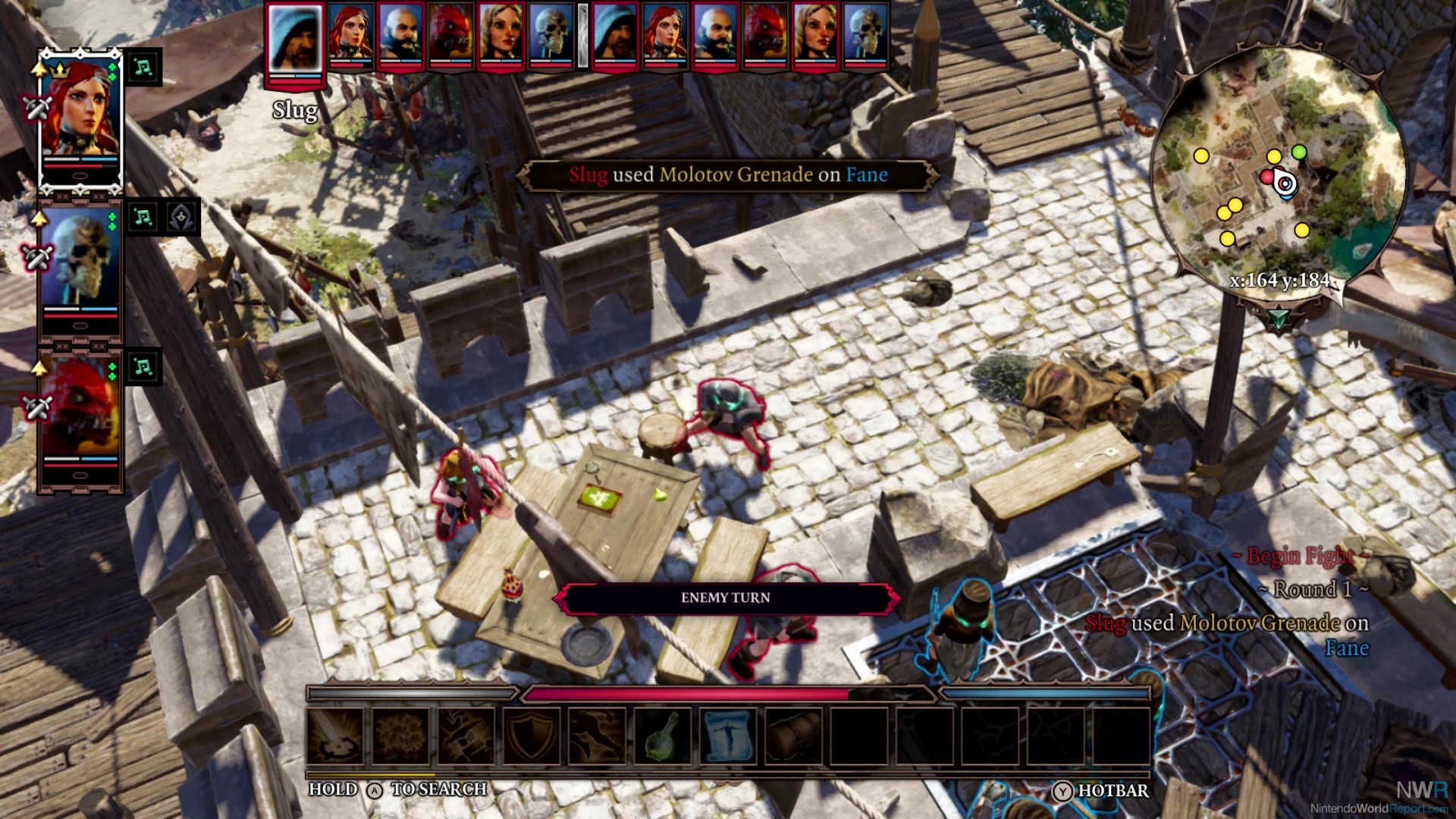
I started to understand combat. Characters start each battle with magic armor and physical armor granted by equipment. These protect against devastating status effects like shocked or crippled. The water barrel and fire grenade combined to make a steam cloud, a great place to hide from physical attacks but a terrible place to hide from shock magic. Movement, attacks, and abilities all pull from a super limited pool of Ability Points, so it made sense to place my other characters strategically as Lohse talked to the guard. I used all my resurrection scrolls, a pretty rare item, to revive my characters during and after our encounter. But with that fallen guard’s key, I was free from Fort Joy.
I realized I had a lot to learn, so I adjusted the difficulty and found a few included mods, like faster movement speed outside of battle. I kept exploring Fort Joy and found multiple ways out. Then, I killed everyone. Dead bodies stay in place for seemingly the entire game, and looting shopkeepers is a lot cheaper than buying items. Fort Joy is a terrible place where they experiment on Sourcerers, so it was mercy.
Fort Joy was just a fraction of the first map. Everywhere I looked, I found a new cave to explore or group of adventurers to help. Divinity offered no real direction, and the difference of even a single level can predetermine a battle’s outcome, so I proceeded with caution. I spent over 20 hours save-scumming my way across the island to freedom. Divinity isn’t the most beautiful game, but I appreciated its diversity of environments and astounding fantasy soundtrack. I got lost here in the best way.
Divinity’s strengths truly start to shine on the second map. Reaper's Coast dwarfs Fort Joy in size and content with almost no barriers to exploration. Shops are fully stocked, and every building houses a mystery. A magic mirror even lets characters reallocate stats. This massive undertaking also brings Divinity’s problems to light. I stumbled into unwinnable fights far too often and never knew where the plot wanted me to go. Scores of empty barrels and boxes became cumbersome to loot. Long reload times and impactful actions added up to hours of retries; I spent a full hour on a dialogue tree with a recruitable bird. I gave those hours willingly, though, gladly trading sleep to crawl toward another corner of the map.
Perhaps most egregious is Divinity's deep character sheets. I was overwhelmed with choices each time I leveled up and got to pour points into stats. Each piece of equipment is so unique that optimizing characters can take hours. In fact, when I had nearly explored the entire map and all my characters were over-encumbered with loot, I sat down for four hours to sort through my items and trade everything I didn't need for anything I might. Ready for battle, I teleported to the final area of the map, and my game crashed. My most recent save was two days prior. Oops.
Perhaps the player most suited to Divinity is one with a lot of time. I thoroughly enjoyed my experience but still felt shaky on mechanics nearly 60 hours in. I spent hours scouring vague message boards for a foothold. I didn't find what I assume to be the main plot until I bombed a wall in a dungeon around hour 40. Divinity begs for multiple 100+ hour replays, a quest I’d gladly accept if time allowed. If anyone is looking for what I feel comfortable calling the biggest game on Switch, Divinity: Original Sin II Definitive Edition deserves your attention. To those who can't spare at least their whole selves to a game, sit this one out. Saving the world from the void is a full-time job.
Large-handed Nintendo fans everywhere wept as Nintendo detailed the tiny, detachable Joy-Con controllers included with every Switch. For years, we massaged our cramped palms between Smash sessions and stared with jealousy at children as they joyfully battled Pokémon on trains and planes for hours. The Pro Controller was an answer for many, but we were driven back into our game rooms, denied the promise of a portable Switch experience. Until now.
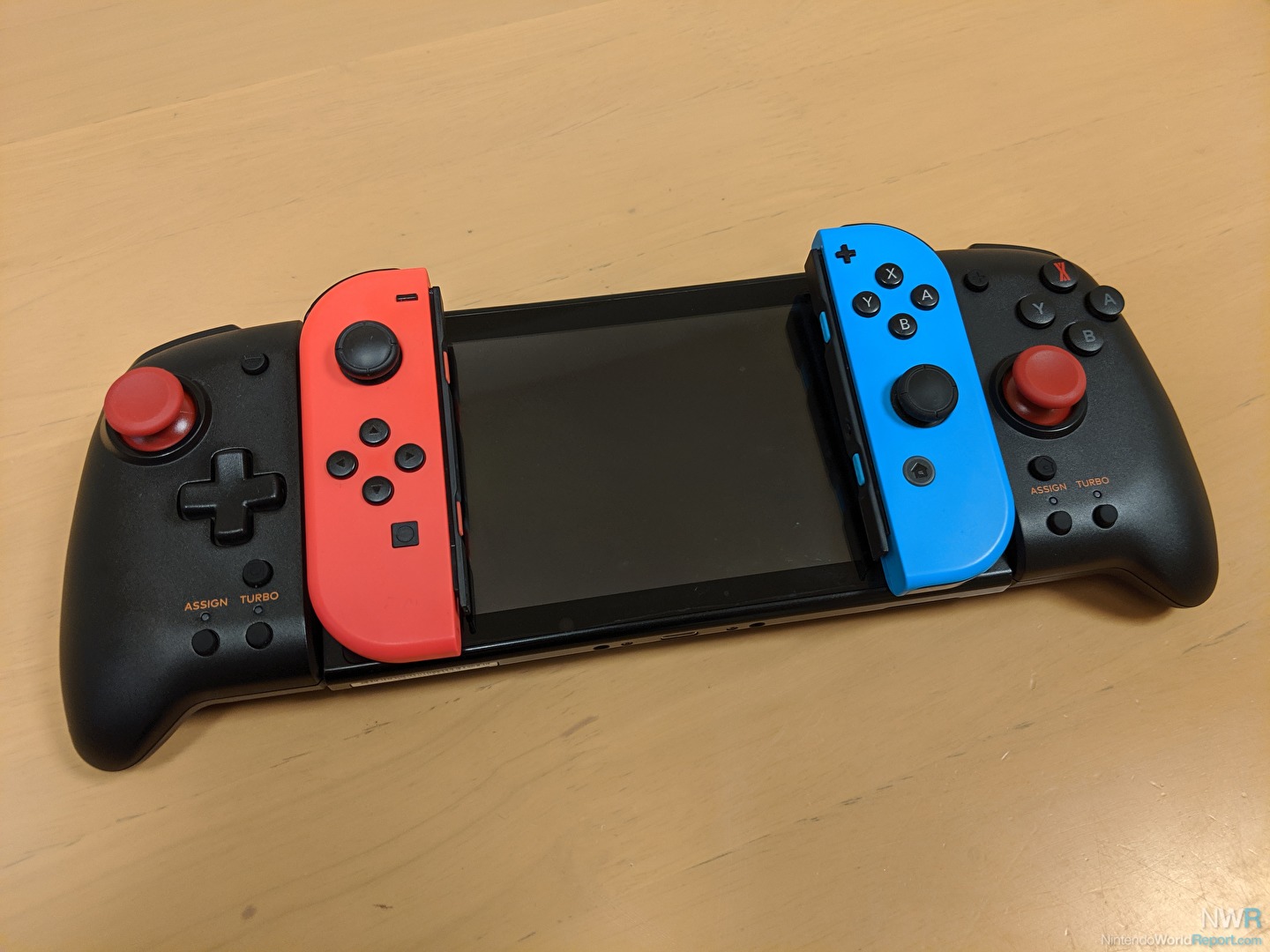
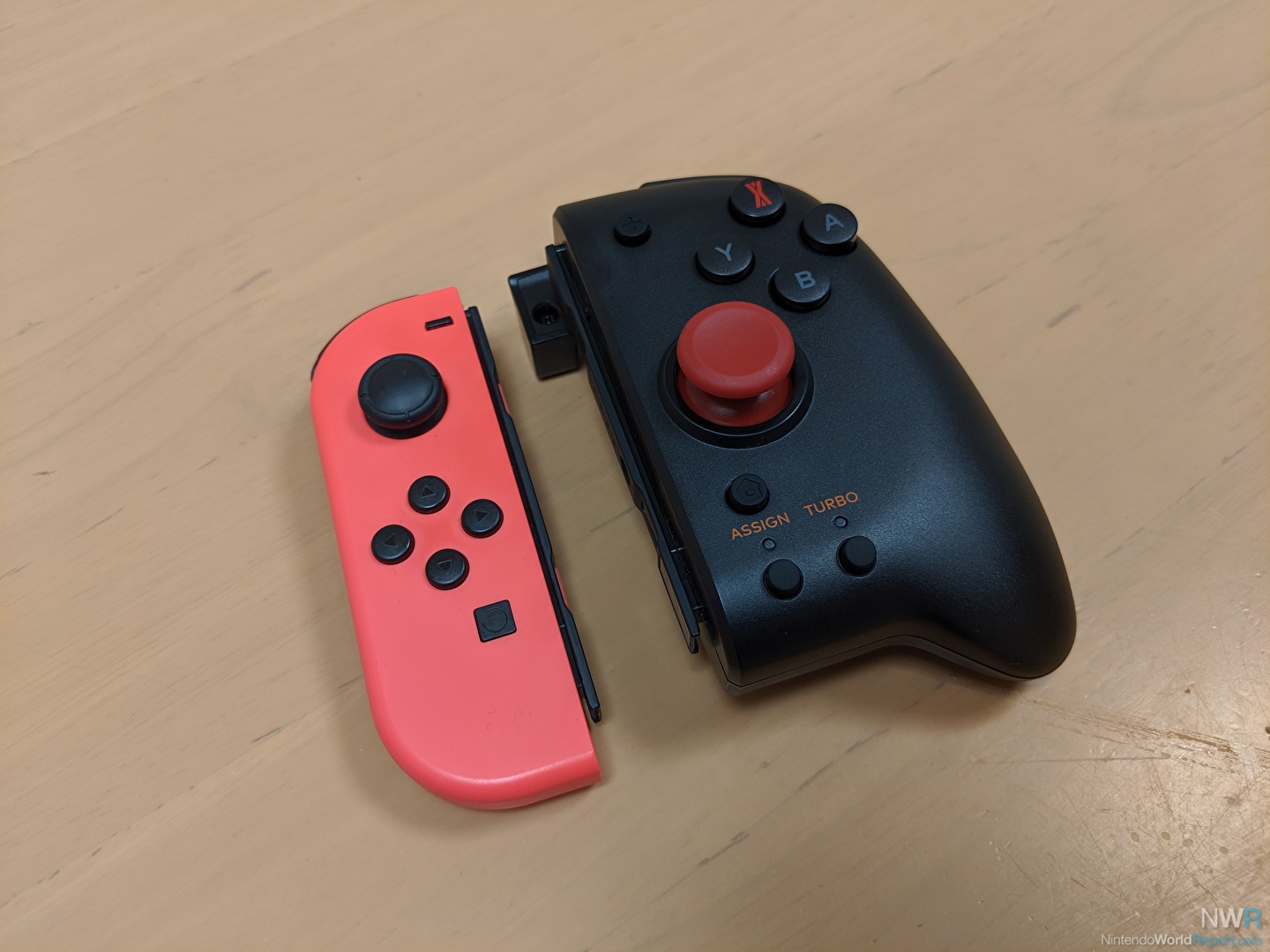
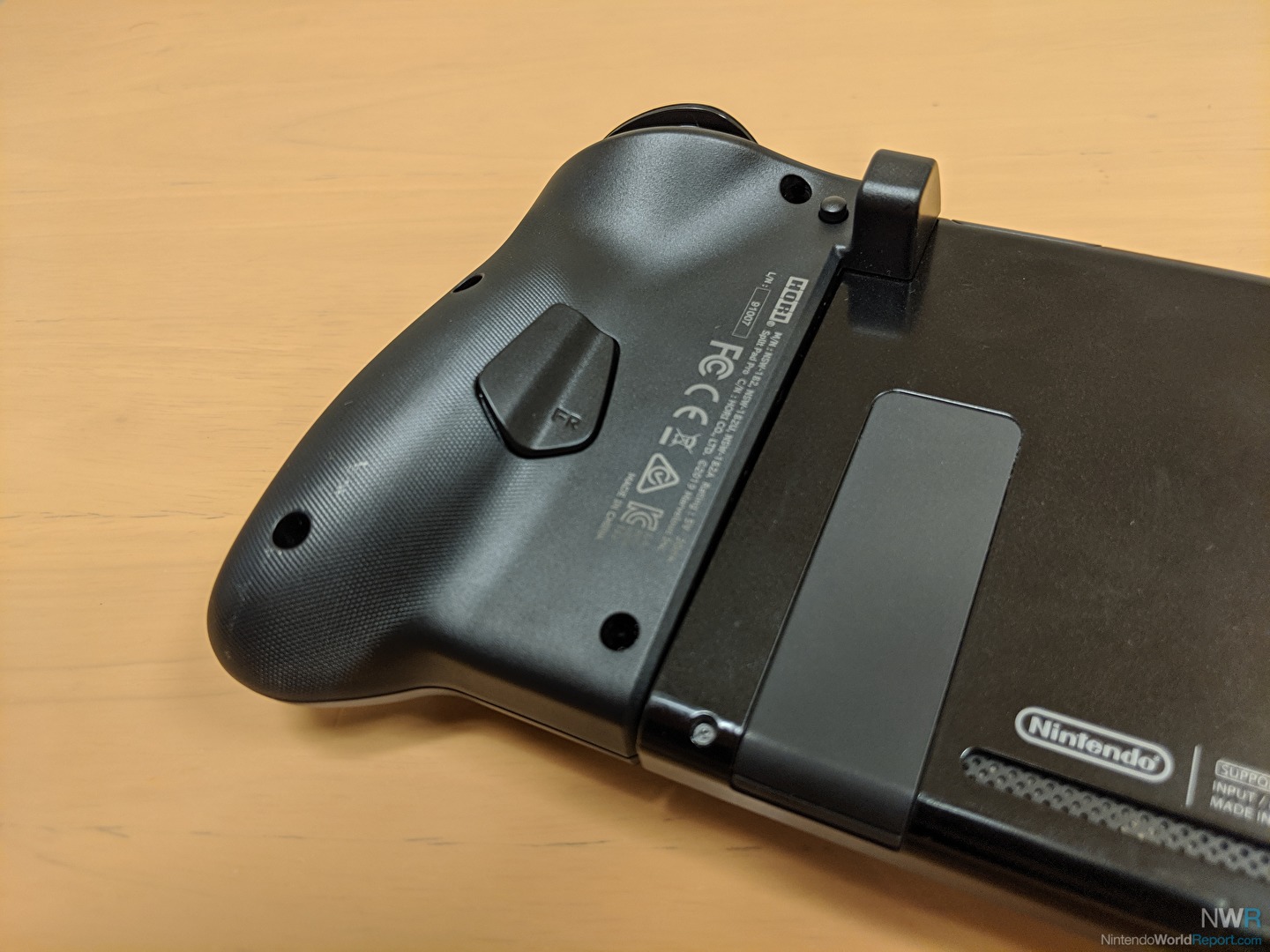
Hori's new Split Pad Pro for the Nintendo Switch is a massive set of handheld-only controllers – and I mean massive. I laughed at the absurdity of this monstrosity when I first held it, unable to comprehend the width. I was reminded of my parents’ SUV during the 2007 gas crisis: large, unnecessary, and oh so comfortable. The curves of the Split Pad Pro give no thought to portability, only to hands. A few extra features are missing, like rumble and wireless, in exchange for a D-pad and programmable rear paddles.
I turned on my Switch to find myself in a dialogue tree in Divinity: Original Sin II Definitive Edition. The Split Pad Pro is thicker than the Switch, adding a depth to the screen that blocked out my surroundings better than the bright neon of my Joy-Con. I felt like I was peering into a world. I chonked my way through options and took notice of the distance between buttons. Inputs aren't too mushy or clicky, but I wonder if someone with smaller hands might need to reposition the Switch to reach other buttons.
Next, I launched Super Smash Bros. Ultimate. I felt like Master Hand on the character select screen, big and menacing. My Young Link darted across the screen well enough, but the big analog stick sometimes took too long to reach the edge of its movement area, leaving me jogging across the stage when I wanted to run. I kept jumping when I meant to attack as my hands adjusted. The travel time between buttons may slow down combos in more traditional fighters, but I didn't have a problem in Smash. The rear ZR trigger seems to go on forever with plenty of room to rest my finger, but the sheer size of the controller put the L and R bumpers just a bit out of reach. Luckily, the rear paddles, just under where a middle or ring finger rests, can mimic any button. I assigned the bumpers to the paddles and could grab with a light squeeze of the controller, quite satisfying in the heat of battle. I hit a side-taunt on the D-pad when I wanted an up-taunt as my opponent flew off the screen.
To better test the D-pad, I moved on to my most played games on Switch: the Japanese demo for Puyo Puyo Tetris. While I initially felt the expansiveness of the D-pad, I quickly got lost in my match. Pieces moved as I willed, either through quick taps or a long press. No piece moved one to the side before I dropped it, a problem I’d had on Nintendo's Pro Controller. For the first time, the Split Pad Pro switched from input method to game-control conduit; everything melted away but Tetris. I'm no twitch-platformer, but this D-pad delivered where I needed it to. The analog stick was a different story. I felt like I was playing Tetris on stilts high above the screen. I lost a few clicks to the stick's big dead zone, and a few of my pieces did move to the side when I asked them to drop. I did get a bit excited by the sound of the stick bouncing back in place after I flicked upward, and I don't like to blame controllers for lost games, but I did lose twice in a row while using the analog stick.
The Split Pad Pro is technically Daemon X Machina-themed but draws little attention. The X button is replaced by the X from Daemon X Machina's logo, and the analog sticks are red to match. The rest of the controller is a black that blends well with the Switch. Two little textured handles dip out to add curves to grip and somewhere for pinkies to rest. The Switch still fits in its dock but won't stand on its kickstand with the controllers attached. Surprisingly, the Split Pad Pro might be lighter than traditional Joy-Con without feeling cheap.
Hori's Split Pad Pro solves a very specific Switch problem well. While I might need a bigger bag when I take my Switch out, I'll probably use the Split Pad Pro in most cases going forward. Finally, we giants can walk among other Switch owners again.
Super Cane Magic Zero doesn’t take itself seriously. In this silly action RPG, players must gather scattered wizards to save the world from a magical dog whose barks wreak havoc on the world. My character thought he was a comet, and NPCs responded with mostly nonsense. I really wanted to love Super Cane Magic Zero, but its gameplay just frustrated.
Enemies drop a huge variety of weapons, like battering plungers and magic grenade launcher, each with different strengths, speeds, ranges, and stun ratings, but they were all too slow and weak for me to bother with. Enemies usually pummeled me or knocked me down whenever I got close enough to attack, and my extremely slow movement made it impossible to break out of a dogpile. Instead, I threw the objects scattered throughout the world at enemies. However, enemies moved quickly and throws often missed. Most of those objects were food that heal a tiny amount of health (and leave you open to an attack), forcing me to eat my weapons. Some items hurt to consume instead of heal, making every enemy encounter stressful and unpredictable.
Most puzzles require the player drop an item on a pressure plate to open a door, but if I had eaten all the items in the room, I would haved to trek back through the level until I found something to carry. A lot of items slow the player down even more, and enemies respawn quickly. Pressure plates that require a specific magic rock from elsewhere in the level must be an example of the hellscape the magic barking dog created.
Quests think they’re hilarious. The quest log is full of mostly gibberish locations and character names and little direction. One character sent me across several levels to find and remember the details of an otherwise comically incomprehensible story scrawled on pizza boxes, only to open a portal to a dimension that required I scour other levels for portals into that same dimension in order to unlock doors. A forest gave me a cryptic clue about how to navigate its labyrinth of doors only to spit me back to the entrance of its awful combat gauntlet over and over for hours.
I had some fun, I think, when I skillfully dodged and darted between enemy attacks, but I'm not sure if I was just lying to myself to get through the repetition. The save launch screen practically begs for multiplayer, but with couch co-op only and no online functionality, Super Cane Magic Zero is about a decade removed from any relevancy.
I'm mostly disappointed in Super Cane Magic Zero. The fun, dumb world and deep RPG mechanics could have hooked me, but the punishing repetition and clunky combat kept me angry through almost all of my playtime. An extremely specific group of hardcore goofballs could have fun with Super Cane Magic Zero, but most players can find a better use for a group of friends.
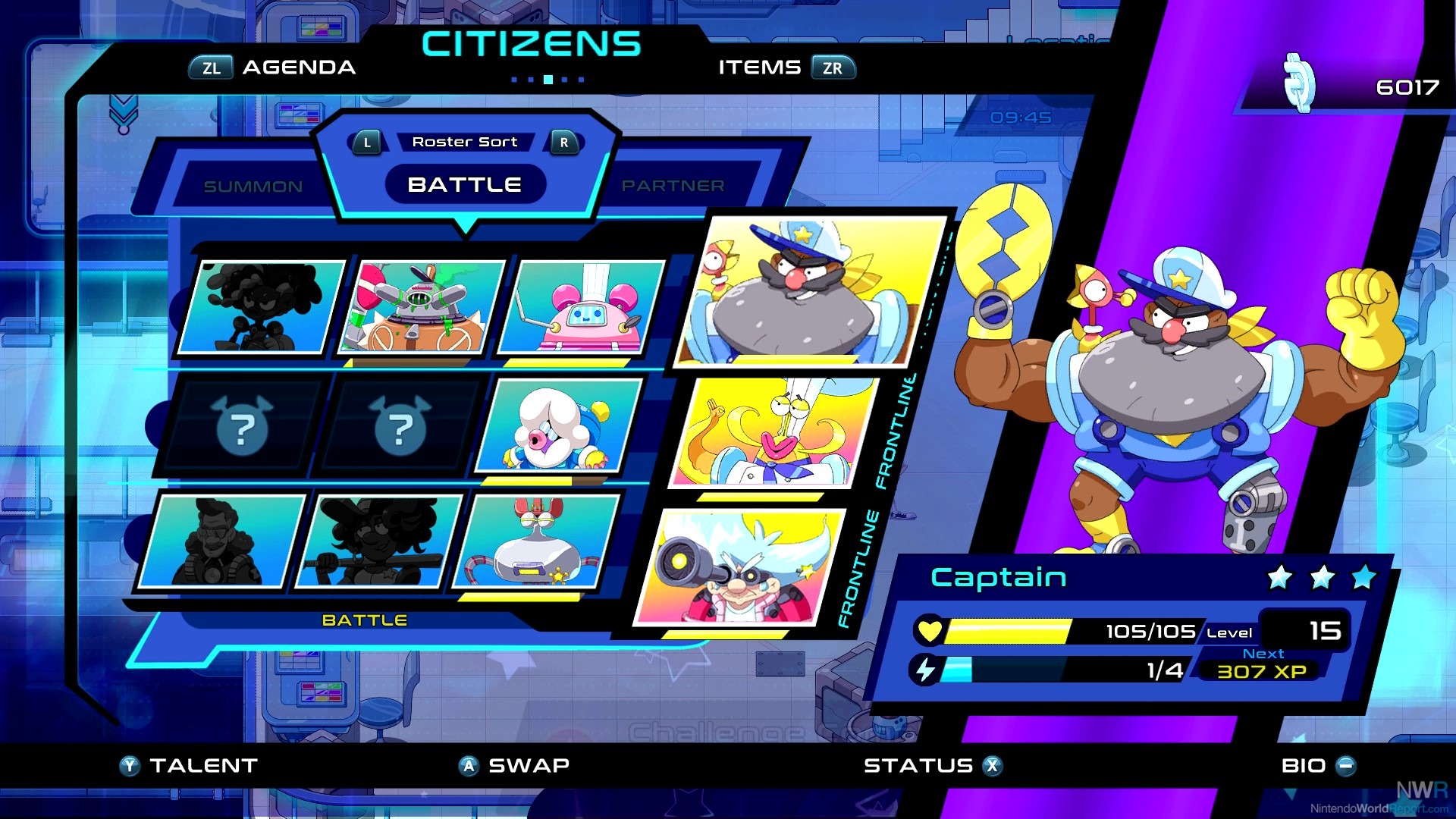
Earth disappeared on the new galactic ambassador’s first day in Citizens Of Space on Switch. As he journeys through space to find Earth's missing pieces, he recruits 40 party members, each with a unique role.
The turn-based RPG draws cues from other games with timing-based attacks, including a lighthearted tone and charming characters. The 12 playable characters, 12 equipable partners and 16 summons bring a ton of variety to battles. Three party members take the front line. The ambassador doesn't fight, instead swapping citizens and using items. Attacks either fill or empty an energy bar, and most grant a buff or status effect. Every move comes with its own timing microgame, like stopping a gauge or mashing a button. I quickly fell into a favorite team, but replacements hop in when a character falls, so I was punished in boss fights for not getting a feel for everyone’s attacks. Coupled with enemy weaknesses and ever-changing locations, combat stays fresh for the 30-plus-hour adventure.
The ambassador is a little dim, a fact his assistant often points out. His brainy pessimism reigns in the ambassador's sunny disposition enough to differentiate character worldview from the world. Every character has a lot of personality, from the old sea captain to the southern interior decorator who offers to “rearrange your day.” Citizens don't just sit in your party after recruitment, though; they dot the landscape with witty takes on story events. I was luckily always excited to see them as their jokes carry the scenario.
Most of the plot is an A-to-B tour through somewhat inventive worlds. The ice and fire levels are two halves of the same world, the desert area is a resort with apocalyptic weather, and the moon is a robot Western. The worlds house self-contained stories that don't contribute much to the overall plot and feel a bit like a Saturday morning cartoon. The “corporations are evil, government is good” theme worried me a bit when a light parody of the current president showed up, but things stayed tame. I kind of wish he had just been the villain as the game felt ready to end a few times.
Side quests offer the meat of content. Only a few citizens join you through the story, leaving the rest optional. I was surprised by just how different each character’s unlock conditions were. While many are fetch quests, a few took serious exploration that kept me on the lookout throughout missions, and none felt cheap. Three eluded me until the end game, but I felt dumb when I finally found the solutions. Most citizens' abilities add clever mechanics outside of battle, like a bestiary or fast-travel, so everyone feels worth recruiting.
Aiding my exploration was a robust map and quest list. Every exit on the map has markers for quests in that direction, including quests on other worlds. I was frustrated by almost every exit pointing me back to my ship but grateful that obtuse quests were reduced to “explore this specific room.” Holding Y pulls up a waypoint, but every time a quest updates, Y instead becomes a shortcut to the quest list. Sometimes the waypoint just didn't load.
While the art and dialogue of Citizens of Space are top-notch, the actual game feels held together by rubber bands. My session crashed a few times, but the autosave kicked in. The credits list more voice actors than developers, but voices and sound effects sometimes disappear until a reboot. In long battles, turn order continuously resets, turning bosses into one-on-one slogs. Nothing broke the game for me, but it is a shame to see such care poured into the artistic side and so little into the technical side.
Citizens Of Space offers a ton of worthwhile content for anyone in search of something light. Technical issues keep the adventure from matching its scenario's quality, but the excellent music plays on in my head. The last 9% of Earth still calls. The galaxy may be saved, but this ambassador ambasses on.
Pokémon Sword and Shield will replace random encounters with overworld models and randomized hiding spots, as shown in the new trailer from today’s Direct.
Creatures still hide in tall grass but alert players with an exclamation point. Other Pokémon roam the land and may charge or run away from the player once spotted. At one point in the trailer, the player coaxes a Stufful out from its hiding spot with a whistle.
In tall grass or caves, battles with wild Pokémon will occur when you run into Pokémon that you can see wandering around.
Pokémon Rumble Rush, the fifth entry in the light RPG brawler series, is live first on the Australian app stores, The Pokémon Company announced today.
The "free-to-start" title sees Pokémon battle through wild hoards to unlock new Pokémon and equipment. The tap-control levels lead to "Super Bosses" on each island.
Pokémon Rumble Rush releases in other regions soon, the company said.
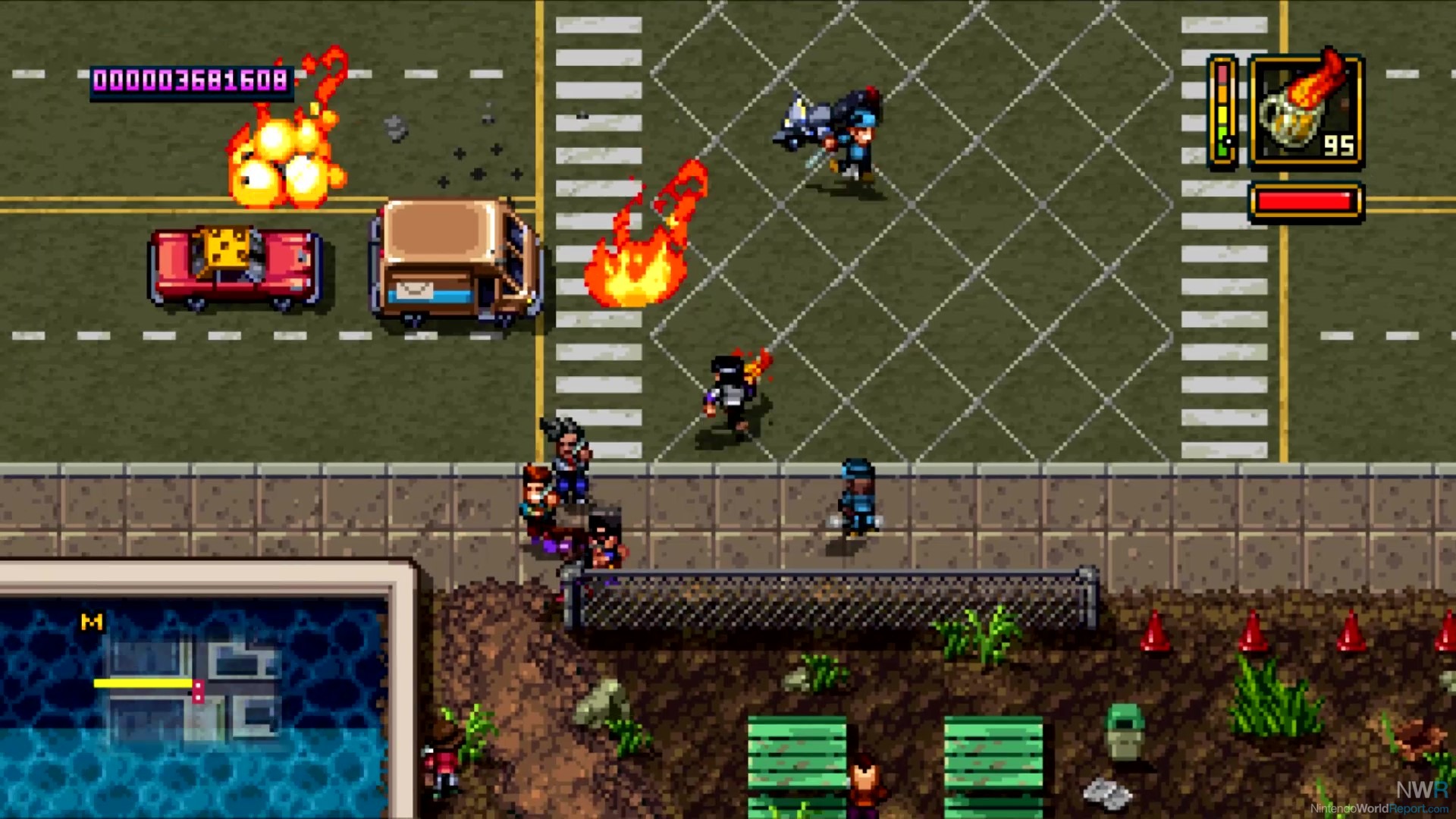
Retro City Rampage DX was a Grand Theft Auto parody full of puns and pop-culture references. Everything about it worked together to support the time-travelling criminal premise. It was my first 10/10 review. I was excited to see that Vblank’s follow-up, Shakedown: Hawaii, returned to the format with an updated art style, new location, and light city-building. But while Rampage's ideas all worked in tandem, Shakedown: Hawaii seems to work against itself.
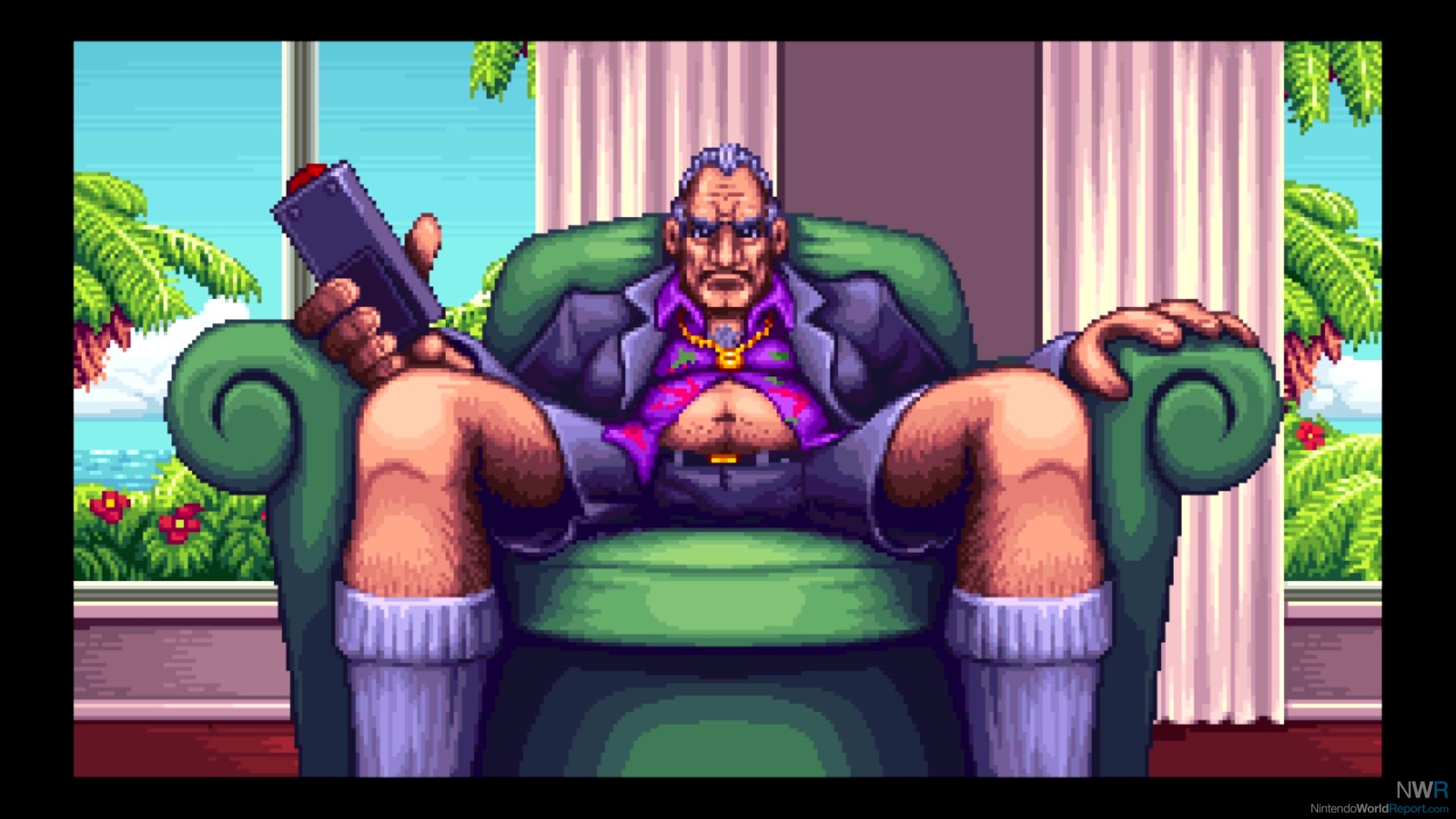
The player controls a grumpy CEO and author of “My Company Runs Itself: I'm at the Beach” with his company at the brink of bankruptcy. The CEO rises from his recliner to intimidate his competition into corporate takeovers. These missions see him travel across the Hawaiian island to shakedown small businesses through mob-style terrorism. Each store has its own requirements, like scaring off customers or destroying inventory. I'd shaken down the entire island within two hours.
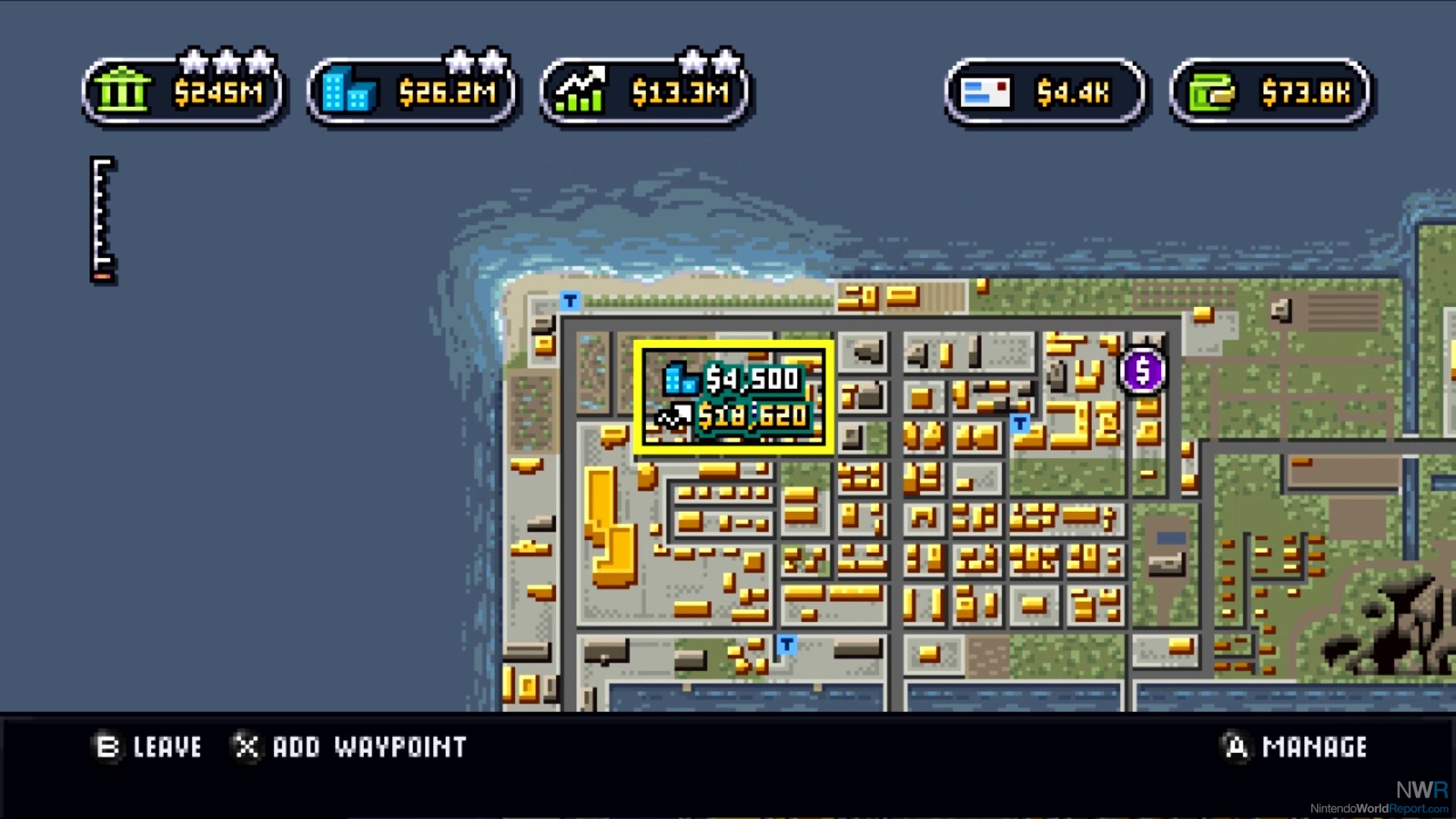
The company makes a daily profit every few in-game minutes. Players can spend this money to buy businesses or exploitative marketing multipliers, like targeted ads and convenience fees. This is Shakedown: Hawaii’s unfinished focus. After a short bathroom break, I returned with enough money to buy almost the entire island. The uncooperative menu fought me after each purchase. I spent enough time on upgrades to memorize the button presses and maxed everything on autopilot. Real thrilling gameplay. I quickly amassed enough cash to clear any upcoming story hurdles hundreds of times over.
Story missions are dull. Most often, the CEO just drives from business to business to undo or react to some business mistake he made in a previous cutscene. While speeding through town and plowing through almost anything is a blast, that feels more like a leftover than a core mechanic. Only a few missions, starring a mysterious Spanish speaker taking over cartel businesses for the company, offer much action or challenge. Thankfully, when I had reached my absolute limit of cutscenes, the story abruptly ends.
Perhaps the shakedown missions were meant to be the meat of the game, sprinkled throughout the city like Hyrulian shrines, but they were far too easy and accessible from the start. Instead, most of my enjoyment came from stealing a car and torching everything in sight with a flamethrower. The CEO’s playable adult son, Scooter (or DJ Jockitch), is an insufferable send-up of “kids these days,” and the CEO is too cynical a parody of X-treme Capitalism. The observational marketing jokes just don’t land. At least the music kicks.
I'm not mad at Shakedown: Hawaii, just disappointed. Vblank demonstrated a deep understanding of mechanics-based story cohesion in its last release, but that seems to be forgotten here. The disconnect between plot and play in Shakedown leave both shallow and underwhelming.


 Show Posts